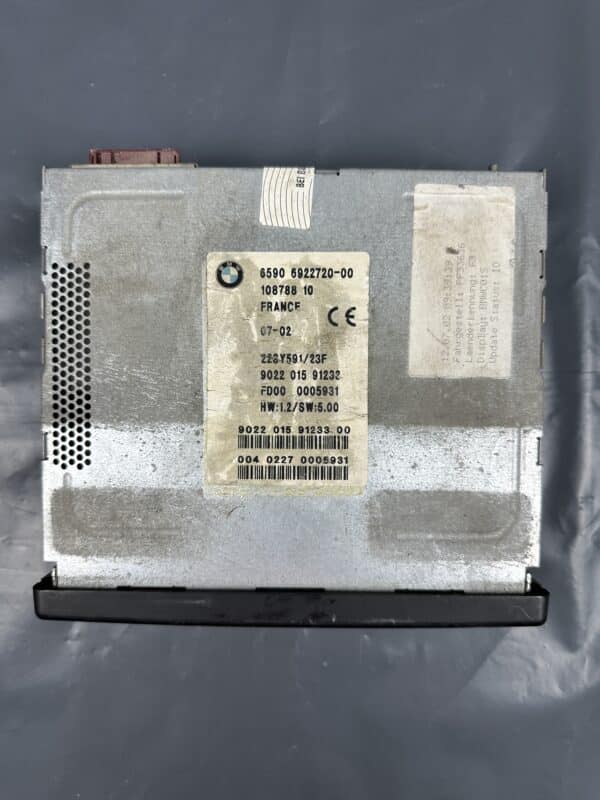
BMW E46 3-Series EWS Immobilizer Faults: Symptoms and Repair
The EWS (Elektronische Wegfahrsperre) immobilizer on the BMW E46 is a dedicated anti-theft module that communicates with the DME engine control unit and the transponder ring around the ignition barrel. When it fails — or loses synchronization with its partners — the car simply will not start. No crank, or cranks but refuses to fire. It is one of the more frustrating electrical faults an E46 owner can face because the symptom looks exactly like a dead battery or a bad starter, and many workshops waste time chasing the wrong thing.
What Exactly Is the EWS Module?
The EWS III system fitted to most E46 models (produced from 1998 onward) is a small black control unit typically located behind the instrument cluster or inside the dashboard. Its job is straightforward: it reads the rolling code from the key’s transponder, confirms it matches the DME, and only then allows the engine to start. The DME and EWS exchange an encrypted rolling code at every start attempt. If either side disagrees, fuel injection is blocked and the engine will not run for more than a second — if it fires at all.
Unlike many chassis faults, a bad EWS leaves almost no obvious clues. The battery is fine, the starter motor turns the engine, but nothing happens. Sometimes the immobilizer warning light in the cluster stays on or flashes. Sometimes it does not light at all. That inconsistency is precisely what makes this module so easy to misdiagnose.
Common Symptoms of EWS Failure on the E46
- Engine cranks but does not start — most frequent complaint
- Intermittent no-start that then resolves itself after multiple key attempts
- Immobilizer warning light flashing on the instrument cluster
- Car starts fine for weeks, then suddenly refuses — often in cold or damp weather
- DME stores communication fault codes even though the DME itself is undamaged
- Remote central locking still works, but the car will not fire
Intermittent behaviour is actually the most telling symptom. A completely dead EWS usually produces a consistent no-start. An EWS that is beginning to fail — perhaps due to a cracked solder joint on the circuit board or a failing clock crystal — will act up randomly, often triggered by temperature changes or vibration. Several owners have reported that the car starts perfectly during the day but refuses first thing in the morning in winter. For comparison, see BMW E46 3-Series EWS Immobilizer Faults: Symptoms and Repair.
Common Fault Codes — EWS and DME Communication
| Fault Code | Description |
|---|---|
| P1624 / 41.00 | EWS signal not received by DME — no communication from immobilizer |
| P1625 / 42.00 | EWS rolling code mismatch — synchronization lost between EWS and DME |
| P1630 | Coding error between EWS and DME — usually after a module swap without coding |
| P1631 | Start signal error — EWS not authorising the start relay |
| P1640 | Internal EWS fault — module hardware failure |
These codes must be read using BMW-compatible diagnostics — INPA, ISTA, or a quality OBD2 reader with BMW-specific coverage. A generic OBD2 scanner may show nothing at all because the EWS communicates on its own K-line, not just the standard OBD port.
Root Causes — What Actually Goes Wrong
The most common hardware failure is a cracked solder joint on the EWS circuit board, specifically around the clock crystal and the main processor. BMW E46s are now 20-plus years old, and the constant heating and cooling cycles eventually cause microfractures. This explains the temperature-sensitive behaviour many owners describe.
A second common cause is the transponder ring around the ignition barrel wearing out or developing an intermittent connection. Before condemning the EWS module itself, always check the ring’s wiring harness — a chafed or corroded connector here produces identical symptoms for a fraction of the cost.
Battery drainage is a third factor. If the vehicle sat for months with a flat battery, the rolling code synchronization between EWS and DME can become corrupted. In this case the module hardware is fine, but it needs re-synchronization using BMW diagnostics. A related diagnostic guide is BMW E46 3-Series CAS Immobilizer Module Faults and Repair.
Affected Vehicles
- BMW E46 316i, 318i, 320i, 323i, 325i, 328i, 330i — all petrol variants 1998–2005
- BMW E46 318d, 320d, 330d — diesel variants also use EWS III
- BMW E46 Compact, Touring, Coupe, Convertible — same module across all body styles
- Related platforms: BMW E39 5-Series (1995–2003) uses a similar EWS III unit and shares some failure patterns
- BMW E53 X5 (1999–2006) — also fitted with EWS III, same general fault profile
Common OEM Part Numbers
| OEM Part Number | Application |
|---|---|
| 61.35-6 917 875 | EWS III module — E46 petrol variants, early production |
| 61.35-6 920 963 | EWS III module — E46 updated version, mid-production |
| 61.35-8 368 986 | EWS III module — later E46 facelift models 2001–2005 |
| 61.35-6 921 506 | Transponder ring (ignition coil antenna) — all E46 models |
| 61.35-6 943 440 | EWS control unit — E46 diesel variants |
Always confirm the part number against the vehicle’s build date and engine code. A tested used OEM EWS module sourced from a car with an identical engine variant is the safest approach — it minimizes the coding work required and ensures hardware compatibility. Matching the DME number on the replacement unit is also good practice before purchase.
Replacement and Coding — What the Workshop Needs to Know
Swapping an EWS module is not plug-and-play. The replacement unit must be synchronized to the DME and all keys must be re-coded. This requires BMW diagnostic software (INPA or ISTA-P) and in some cases the original dealer key codes. Some independent shops use tools like PA Soft or Rheingold to handle this, which works reliably on E46 when done correctly.
A tested used OEM EWS module from a donor vehicle of the same engine type significantly reduces the coding complexity compared to a brand-new unit from NCS Expert, because the hardware profile is already familiar to the BMW system. Workshops across Europe regularly source these units from reputable OEM parts suppliers and pair them with fresh key coding — it is a well-established repair route for the E46.
FAQ
Why does my BMW E46 crank but not start?
A no-start condition where the engine cranks normally but will not fire is a classic EWS immobilizer symptom on the E46. The EWS blocks the fuel injection signal when it does not recognize the key transponder or loses synchronization with the DME. Read fault codes with BMW-specific diagnostics before replacing any parts — the code will confirm whether EWS communication is the cause.
Can I drive with a faulty EWS on the BMW E46?
No. A fully failed EWS will prevent the car from starting at all, making it undrivable. An intermittently faulty EWS might allow occasional starts, but this is unreliable and will worsen over time. The fault should be diagnosed and resolved promptly — leaving it causes additional stress on the DME’s communication circuits. For additional context, read BMW E90 3-Series EWS Immobilizer Faults Common Symptoms and Repair.
How much does it cost to replace an E46 EWS module?
A tested used OEM EWS module for the E46 typically costs between €40–€120 depending on the specific variant and sourcing region. Add workshop labour for coding and key synchronization, which is usually 1–2 hours. A new unit from BMW dealer stock is significantly more expensive and still requires the same coding procedure.
Will a second-hand EWS work without coding on my E46?
Not directly — a used EWS module must be coded to match the DME and the ignition keys of the receiving vehicle. However, starting with a used unit from an identical engine variant simplifies the process. The rolling code synchronization is performed using BMW diagnostic software, and all keys must be presented during the coding session.
How do I know if it is the EWS module or the transponder ring that is faulty?
The transponder ring (the antenna coil around the ignition barrel) is cheaper and more accessible than the EWS module — always check it first. Inspect the wiring harness connector at the ring for corrosion or damage. If fault codes point specifically to EWS internal hardware errors (P1640) rather than signal/communication errors, the module itself is more likely the culprit. A workshop with INPA access can test the ring and EWS independently in minutes.
Find tested OEM electronic parts and modules at:
https://giantparts.eu/
Related diagnostic guides and OEM parts
- BMW E39 5-Series EWS Immobilizer Faults: Symptoms and Repair
- BMW E38 7-Series EWS Immobilizer Faults Symptoms and Repair
Browse the category: Ignition Lock, Key & Immobilizer Control Modules