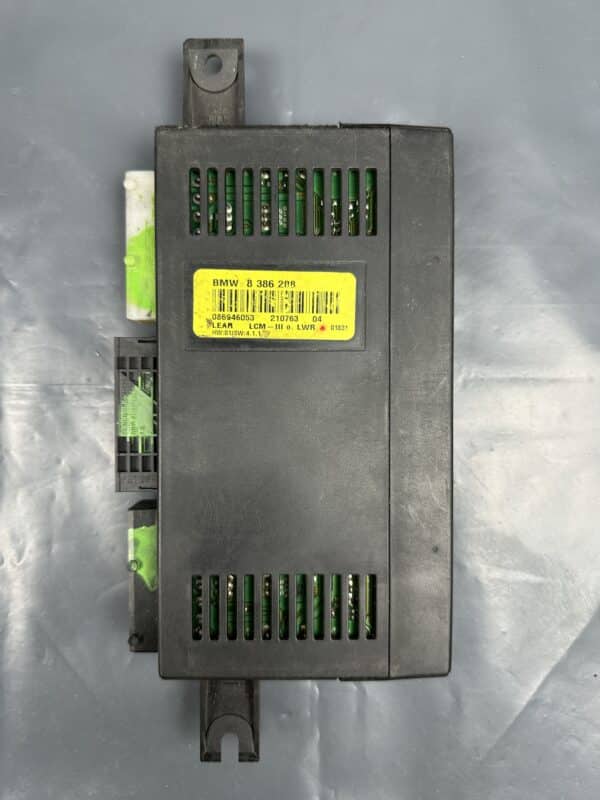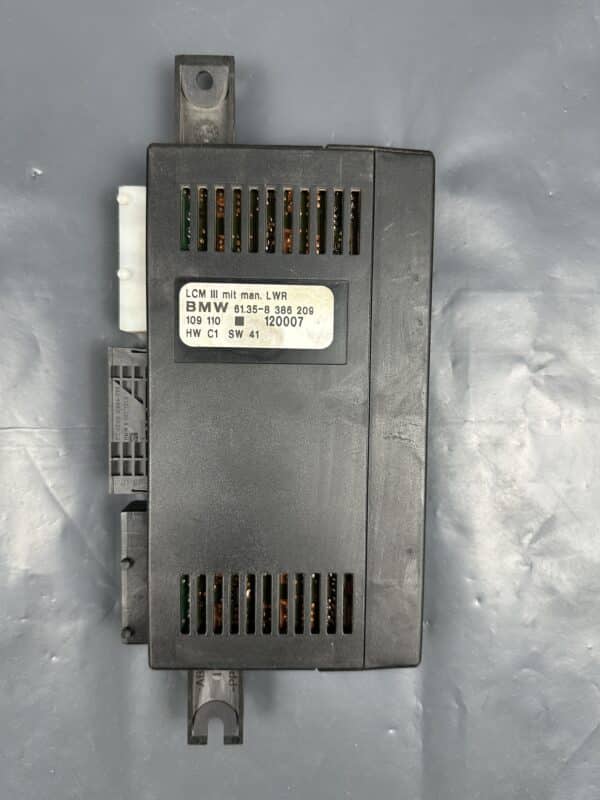


BMW E60 5-Series FRM Footwell Module Faults and Repair Guide
The FRM (Footwell Module) in the BMW E60 5-Series is one of those components that can cause an absolutely bewildering range of electrical faults when it starts to fail. It controls exterior lighting, turn signals, interior lighting, central locking, and communicates constantly over the K-CAN bus. When it dies — or half-dies — the car becomes unpredictable. Expect random lights going out, doors not locking, or a complete no-start situation with no obvious cause.
Quick Answer
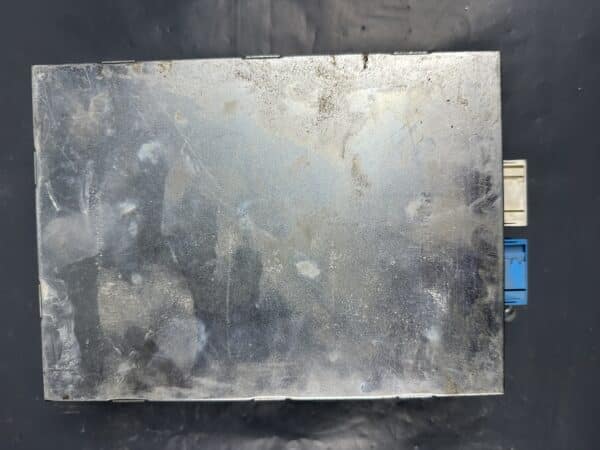
The BMW E60 FRM Footwell Module is a body control unit located under the driver-side dashboard that manages lighting, central locking, and CAN communication. Failure is most commonly caused by moisture ingress or voltage spikes during battery replacement. A failed FRM can be rebuilt or replaced with a tested used OEM unit coded to the vehicle.
What Symptoms Point to an FRM Failure?
In the workshop, E60s with FRM problems usually come in with a cluster of unrelated-looking faults. That is actually the giveaway — when you have three or four lighting and convenience faults on a car that otherwise runs fine, the FRM is the first suspect.
- Exterior lights not working — headlights, taillights, or both
- Turn signals inoperative or flashing at the wrong speed
- Interior footwell lights permanently on or completely off
- Central locking failing intermittently or not at all
- Car won’t start; CAS reports no communication with FRM
- Dash warning lights for lighting system faults
- Rain sensor and auto-wipers stop responding
One thing worth noting: a partially failed FRM often behaves worse in wet weather. That is not a coincidence. The module sits low in the footwell and is vulnerable to water that gets in through blocked A-pillar drains or a leaking pollen filter housing — a known weak point on the E60 platform. For comparison, see BMW E60 5-Series DME Failure: Common Faults and Diagnostic Guide.
Why Does the E60 FRM Fail?
There are three root causes that cover probably 90% of the E60 FRM failures we see.
Moisture damage is the most common. Water tracks down the A-pillar trim and sits in the footwell. The FRM connector and the module itself corrode slowly until signals become unreliable. You will often see green corrosion on the harness connector pins even when the module itself looks dry on the outside.
Voltage spikes during battery change is number two. The E60 is sensitive to any power interruption or spike. Swapping the battery without proper memory savers, or connecting jump leads incorrectly, can kill the FRM outright. Always register a new battery with ISTA/NCS Expert on these cars.
Software corruption is less common but happens, especially if someone has connected cheap scan tools that write incorrect data to the module. A corrupted FRM can sometimes be recovered through forced programming, but not always.
Common Fault Codes for BMW E60 FRM
| Fault Code | Description |
|---|---|
| A462F | FRM: Supply voltage fault — internal power supply issue |
| A4629 | FRM: CAN communication fault with CAS module |
| A4614 | FRM: Left dipped headlight output — open circuit |
| A4615 | FRM: Right dipped headlight output — open circuit |
| A4618 | FRM: Tail light output — short circuit to ground |
| A4620 | FRM: Interior lighting control — plausibility error |
| A462A | FRM: EEPROM write error — module data corrupt |
You will typically find these stored in the FRM fault memory directly. Some will also appear in the CAS if the FRM has lost CAN communication entirely. Always read all control units, not just the one with the obvious symptom.
Which E60 Variants Are Affected?
Affected Vehicles
The FRM Footwell Module was fitted across the entire E60/E61 platform from the 2003 facelift onwards, and the failure pattern is consistent across engine variants.
- BMW E60 520i, 523i, 525i, 528i, 530i, 535i — 2003 to 2010
- BMW E60 520d, 525d, 530d, 535d — same period
- BMW E61 5-Series Touring — identical FRM hardware and failure modes
- Pre-LCI (2003–2007) and LCI (2007–2010) models both affected, though part numbers differ
The E63/E64 6-Series shares the same FRM unit with the E60. If you are sourcing a replacement from a 6-Series donor car, the part must match exactly — LCI vs pre-LCI matters here. A related diagnostic guide is BMW E60 5-Series CAS Module Failure: Symptoms and Repair Guide.
OEM Part Numbers for BMW E60 FRM Module
| OEM Part Number | Application |
|---|---|
| 61359231483 | FRM2 — E60/E61 pre-LCI, standard lighting |
| 61359231484 | FRM2 — E60/E61 pre-LCI, xenon lighting variant |
| 61359263344 | FRM3 — E60/E61 LCI (2007 onwards) |
| 61359263345 | FRM3 — E60/E61 LCI, adaptive headlight variant |
| 61356948506 | FRM — E63/E64 6-Series compatible variant |
Always cross-reference the part number printed on your existing FRM before ordering. The LCI and pre-LCI units are not interchangeable without reprogramming, and even then the xenon/adaptive headlight variants need the matching hardware.
Repair or Replace: What Makes Sense?
FRM repair services exist and are popular for the E60 — specialists can often reball the main processor chip and restore a water-damaged unit. This makes sense if the module is otherwise intact and the failure is clearly moisture-related. Cost is usually lower than a replacement unit.
However, if the EEPROM is corrupt or the module suffered a voltage spike, repair is a gamble. In those cases a tested used OEM FRM, sourced from a low-mileage European donor car and matched to the correct variant, is the more reliable route. A tested unit from a reputable supplier will have been bench-verified before shipping — far better than a random eBay listing.
Either way, after fitting a replacement FRM you must code it to the vehicle using BMW ISTA+ or NCS Expert. The module needs the car’s VIN and equipment data flashed into it, otherwise the lighting functions will not operate correctly and the CAS will report a mismatch.
Frequently Asked Questions
Can I drive my BMW E60 with a failed FRM?
In most cases, no — or at least not safely. A failed FRM typically kills exterior lighting, which is both illegal and dangerous. In severe cases the car will not start at all because the CAS cannot complete its handshake with the FRM over the K-CAN bus. Get the car diagnosed before driving it further.
Will a used FRM from another E60 work in my car?
Yes, but it must be programmed to your vehicle after fitting. A used FRM retains the previous car’s data and will not work correctly out of the box. You need BMW-compatible diagnostic software — ISTA+ or NCS Expert — to code the module to your car’s VIN and option list. This is a standard workshop procedure and takes around 30 minutes. For additional context, read BMW E60 5-Series EGS Transmission Control Module Faults Guide.
How do I know if it is the FRM and not a wiring fault?
Read the fault memory in the FRM module directly using a BMW-compatible scanner. Internal FRM fault codes — especially EEPROM errors, supply voltage faults, or output stage faults — confirm the module itself. If the FRM shows no power or does not respond to the scanner at all, check fuse 27 in the rear fusebox and the FRM ground connection first before condemning the module.
What causes the E60 FRM to get wet?
The most common path is a blocked or cracked pollen filter housing drain, which allows water to run down behind the dashboard and pool in the driver’s footwell. The A-pillar drain channels can also block with debris, redirecting water inward. Regularly clearing these drains — especially before winter — is good preventive maintenance on any E60.
Is the FRM the same on the E60 and E61 Touring?
Yes, the FRM hardware is the same across E60 saloon and E61 Touring. The part numbers match for the same production year and equipment level. The E63 and E64 6-Series also use the same FRM family, though you must verify the exact part number before swapping units between platforms.
Summary
The BMW E60 FRM is a well-known failure point, but it is also a well-understood one. Correct diagnosis with BMW ISTA, careful part number matching, and proper coding after replacement will get the car back to full function. If you are sourcing a replacement, go for a tested used OEM unit from a verifiable European source — it is the most cost-effective and reliable solution for most owners.
Find tested OEM electronic parts and modules at:
https://giantparts.eu/