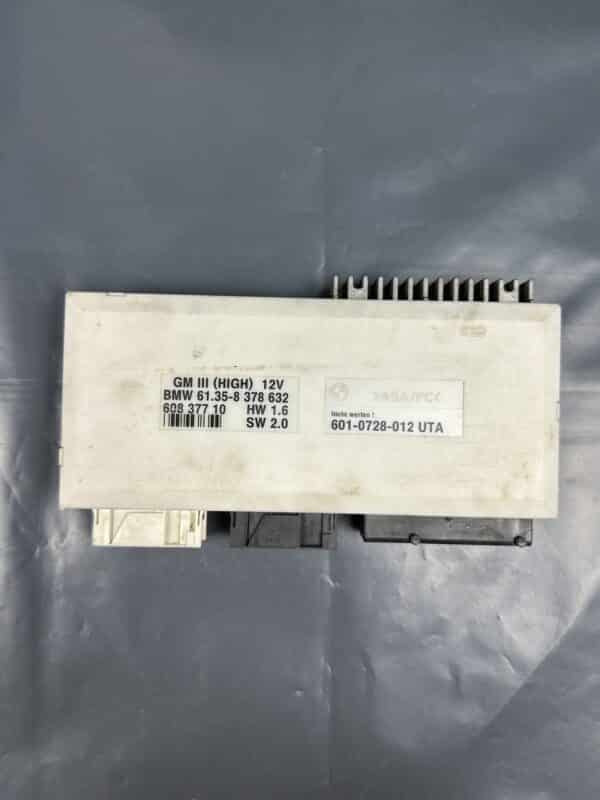


BMW E83 X3 ABS Control Module Failure: Symptoms and Repair Guide
The ABS control module on the BMW E83 X3 is one of those components that fails quietly at first — an orange warning light here, a slightly odd brake pedal feel there — and then suddenly the car is telling you DSC is offline, ABS is gone, and the hill-start assist has vanished along with it. This is a known weakness on the E83 platform, and it catches a lot of owners off guard because the X3 is generally considered a robust vehicle.
Quick Answer
The ABS control module (also called the DSC control unit or ABS/DSC pump assembly) on the BMW E83 X3 is an integrated hydraulic unit and ECU. When it fails, you will typically see ABS, DSC and brake warning lights illuminated simultaneously, with fault codes pointing to internal module faults or wheel speed sensor communication errors. In most cases the hydraulic pump body is reusable — it is the electronics side of the unit that fails, and a tested used OEM replacement ECU section is usually the most cost-effective fix.
What Does Failure Actually Look Like?
The failure pattern on E83 X3s built between 2003 and 2010 is remarkably consistent once you have seen it a few times. The car comes in with multiple warning lights — ABS, DSC, the yellow triangle, sometimes a brake warning. The driver often reports that the lights came on after wet weather or after the car sat for a few days. That last detail is telling: moisture ingress is a significant contributor to these failures.
Common symptoms include:
- ABS warning light permanently on
- DSC (Dynamic Stability Control) inactive warning
- Brake warning light illuminated at startup
- Hill Descent Control (HDC) disabled
- Intermittent brake pedal pulsation with no apparent cause
- All-wheel drive system feeling hesitant or unresponsive on loose surfaces
- No fault codes stored despite visible warnings (early-stage failures)
One thing worth mentioning: the E83 X3 uses either a Bosch or ATE unit depending on the build year and specification. The Bosch DSC 5.7 and DSC 8 units are the most commonly seen in workshops, and the failure modes differ slightly between them. The Bosch units tend to suffer from internal relay failure and PCB corrosion; the ATE units more often show pump motor driver faults. For comparison, see BMW E83 X3 Instrument Cluster Failure: Common Faults and Repair Guide.
Common Error Codes
| Fault Code | Description |
|---|---|
| 5DF0 | DSC control unit — internal fault, replace unit |
| 5DF1 | DSC pump motor — plausibility fault |
| 5E20 | Wheel speed sensor, front left — signal implausible |
| 5E21 | Wheel speed sensor, front right — signal implausible |
| 5E22 | Wheel speed sensor, rear left — signal implausible |
| 5E23 | Wheel speed sensor, rear right — signal implausible |
| C0031 | Left front wheel speed sensor circuit fault |
| C0034 | Right front wheel speed sensor circuit fault |
| 5E60 | DSC — CAN communication fault with DME |
When you see 5DF0 or 5DF1 stored alongside multiple wheel speed sensor codes, the module itself is almost always the root cause — not four simultaneous sensor failures. The ECU loses its ability to process sensor signals correctly as the internal circuitry degrades.
Root Causes Worth Knowing
The E83 X3 ABS/DSC unit sits in the engine bay in a position that is reasonably exposed to water spray and temperature cycling. Over time, the connector seals age, moisture works its way into the ECU section, and the PCB corrodes. In cold climates this is accelerated by road salt. Some units also fail simply from age — capacitor degradation inside the control electronics is well documented on the Bosch DSC 5.7 across multiple BMW models from this era.
A secondary failure mode is a dead pump relay. When the relay contacts burn out, the pump will not prime on startup and the system throws immediate faults. This can sometimes be repaired by a specialist electronics shop, but replacement is more reliable long-term.
Common OEM Part Numbers
| OEM Part Number | Application |
|---|---|
| 34516757266 | E83 X3 2.0d / 2.5i — DSC control unit (Bosch) |
| 34516771219 | E83 X3 3.0i — DSC unit (Bosch DSC 8) |
| 34516778618 | E83 X3 LCI facelift — updated DSC unit |
| 34516764406 | E83 X3 xDrive — ABS/DSC pump assembly |
| 34516780782 | E83 X3 2.0d M47 — ATE unit variant |
Always cross-reference your build date and engine code before ordering. The E83 ran from 2003 to 2010 with a facelift in 2006 (LCI), and part numbers changed at that point. A mismatched unit will either not communicate correctly or will require specialist coding that may not be possible on all diagnostics setups. A related diagnostic guide is BMW E83 X3 DSC Control Module Faults: Common Failures and Repair.
Affected Vehicles
- BMW E83 X3 2.0i, 2.5i, 3.0i — all build years 2003–2010
- BMW E83 X3 2.0d, 3.0d — diesel variants equally affected
- LCI (facelift) E83 X3 from 2006 onwards — uses updated unit but same failure pattern
- xDrive and non-xDrive variants both affected
- US-market E83 X3 with different DSC calibration still uses the same core module design
Diagnostic Steps Before Buying a Replacement
Before condemning the module, check the basics. Inspect the ABS sensor rings on all four hubs — cracked or corroded tone rings cause multiple sensor codes and can mimic module failure. Pull the ABS unit connector and check for moisture, green oxidation or bent pins. Measure supply voltage at the unit — below 11.5V under load points to a charging or battery issue that will cause DSC faults independently of the module.
If the connector is clean, voltage is good, and you have a stored 5DF0 with no external sensor damage, the module is the culprit. At that point, a tested used OEM unit is the pragmatic choice — new units from BMW are expensive, and rebuilt units vary widely in quality.
FAQ
Can I drive my BMW E83 X3 with the ABS and DSC warning lights on?
Technically the car will still brake, but without ABS and DSC active, you lose anti-lock protection and stability control. On slippery roads this is genuinely dangerous. Short journeys to a workshop are acceptable, but daily driving with these systems inactive is not recommended and may affect your insurance cover in the event of an accident.
How do I know if it is the module or a wheel speed sensor causing the fault?
If you have a single sensor code (e.g. only C0031 for front left), start by inspecting that sensor and its tone ring. If you have four sensor codes plus a 5DF0 internal fault, the module is almost certainly the cause — wheel sensors do not all fail simultaneously. A scope test on the sensor signals while moving the car confirms whether actual sensor output is healthy.
Does the replacement ABS module need coding on the BMW E83 X3?
Yes. The DSC unit requires VIN-specific coding via BMW ISTA/D or ISTA/P after installation. Without this step, the unit will not communicate properly with the DME and gearbox control units. A used OEM unit from the same vehicle type can be coded straightforwardly; make sure you use the correct software version for your build date. For additional context, read BMW E83 X3 Instrument Cluster Faults: Common Failures and Repair.
What is the typical cost of replacing the ABS/DSC module on an E83 X3?
A new BMW OEM unit costs between €400 and €700 depending on variant. A tested used OEM unit in good condition typically runs €80 to €200. Labour for removal and refitting is around 1–1.5 hours, with additional time for coding. Rebuilding the existing unit by a specialist is another option at €150–€300 but availability varies by region.
Can a faulty ABS module cause the E83 X3 automatic gearbox to behave oddly?
Yes. The DSC module shares CAN bus data with the automatic gearbox TCU. When the DSC unit sends corrupted or absent wheel speed data, the gearbox can exhibit hesitant shifts, hold gears longer than normal, or refuse to engage hill-start assist. Repairing the DSC unit usually resolves these secondary symptoms without any gearbox intervention needed.
Tested OEM Replacement Advice
When sourcing a replacement DSC/ABS module for the E83 X3, match the part number to your build date and engine variant precisely. A tested used OEM unit pulled from a donor car with matching specification is often the best balance of cost and reliability — providing it has been bench-tested for pump function and internal communication before dispatch. GiantParts sources and tests these units across European workshops and offers worldwide shipping, which makes finding a correctly matched unit far simpler than searching locally.
Find tested OEM electronic parts and modules at:
https://giantparts.eu/
Related diagnostic guides and OEM parts
- What Happens When the BMW E83 X3 CAN Gateway Module Fails
- BMW E39 5-Series ABS Module Failure: Diagnostic and Repair Guide
Browse the category: ABS-Pumpen- und Steuermodule