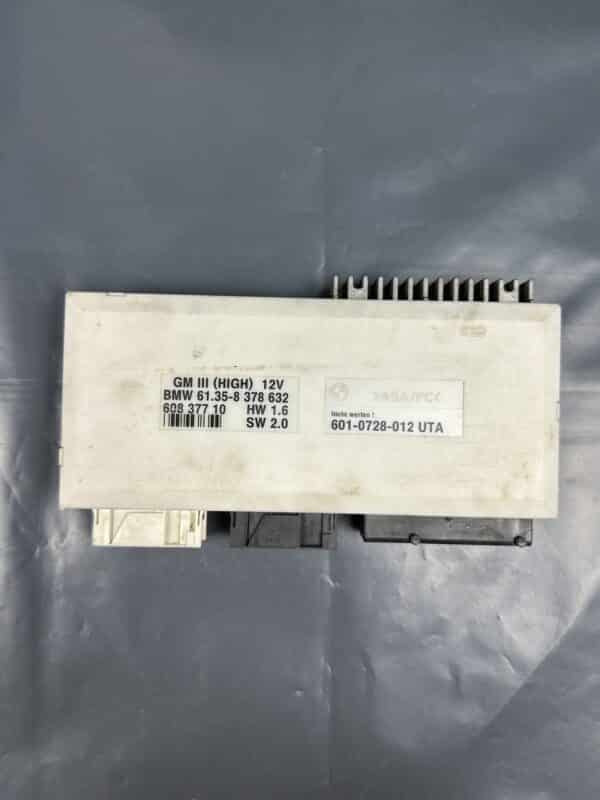
When the Mercedes W140 S-Class Ignition Control Module Causes No-Start
The ignition control module on the Mercedes W140 S-Class is responsible for managing the ignition timing signal between the engine control unit and the ignition coils. When it fails, the engine typically cranks normally but refuses to fire, because no spark is reaching the cylinders. This is not the same fault as a flat battery or a failed starter — the module failure is often silent, with no warning light and no obvious trigger event.
What the Ignition Control Module Does in the W140
In the W140 platform, which covers the 1991 to 1998 S-Class including the 300SE, 400SE, 500SE, 600SEL and their SEC coupe equivalents, the ignition module acts as an amplifier and switching unit. The ECU sends a low-voltage trigger signal, and the module translates this into the high-current switching needed to drive the ignition coils. On the six-cylinder M104 and twelve-cylinder M120 engines this module handles significant electrical load across multiple coils. The V8 M119 uses a different arrangement, but the principle is the same.
Failure occurs gradually or suddenly. Heat is the main enemy. The module is typically mounted on or near the coil assembly in an area that reaches high underbonnet temperatures during normal operation. Over many years, the internal transistors and solder joints fatigue. One day the engine starts fine; the next morning it does not start at all.
Recognising the Fault Pattern
A technician arriving at a W140 with a no-crank-no-start condition will rule out the ignition module quickly. A no-start where the engine cranks freely and fuel delivery is confirmed points directly at ignition. Checking for spark at one cylinder during cranking confirms or eliminates the module in seconds. No spark across all cylinders on a W140, with a known-good crank position sensor signal, is a strong indication the ignition module has stopped switching.
Symptoms that commonly precede a complete failure:
- Engine requires multiple attempts to start, especially when warm
- Rough idle or brief misfires that disappear after a few minutes
- Engine stalls at idle after a long drive, then restarts after cooling
- Intermittent no-start that resolves after waiting twenty to thirty minutes
- No fault codes stored, or only generic misfire codes
The heat-dependent behaviour is a characteristic pattern. If the car starts fine in the morning but fails to restart after a long motorway run, the ignition module should be among the first suspects.
Relevant Fault Codes
Because the W140 uses older OBD1 and early OBD2 architecture depending on year and market, fault code coverage for the ignition module is limited. The codes below are those a technician may encounter using a compatible Mercedes diagnostic tool such as a Star Diagnosis unit or equivalent:
| Code | Description |
|---|---|
| P0300 | Random/multiple cylinder misfire detected |
| P0351–P0356 | Ignition coil primary circuit fault, cylinders 1–6 |
| P0320 | Ignition/distributor engine speed input circuit malfunction |
| 036 | Ignition output stage fault (older MB diagnostic numbering) |
| 037 | Ignition control signal missing (ME/LH system) |
On many W140 vehicles no code is stored at all, because the module failure is complete and no signal reaches the ECU to register a fault event. Absence of codes does not rule out the ignition module.
OEM Part Numbers for the W140 Ignition Control Module
The correct part number depends on the engine and build date. Using the wrong variant can result in timing errors or complete non-function. Always cross-reference the part number against the vehicle’s VIN before ordering.
| Engine | OEM Part Number | Notes |
|---|---|---|
| M104 3.0 / 3.2 / 3.6 (6-cyl) | 0 227 100 124 | Bosch ignition control unit, early W140 |
| M104 3.2 late | 0 227 100 211 | Updated Bosch unit, check production date |
| M119 4.2 / 5.0 (V8) | 0 227 400 127 | V8-specific module, not interchangeable with 6-cyl |
| M120 6.0 (V12) | 0 227 400 137 | Dual-module arrangement on V12, replace both |
| M104 post-1994 | 0 227 100 240 | Updated specification, check compatibility |
The V12 M120 engine uses two ignition modules, one for each bank of six cylinders. If one fails, replacing only the faulty unit is acceptable, but both should be inspected given their identical age and usage conditions.
Affected Vehicles
The W140 S-Class was produced from 1991 to 1998. All petrol engine variants are potentially affected by ignition module deterioration as the vehicles age. The most common age band for failure is now vehicles with more than 150,000 kilometres that have not had the module inspected or replaced. The W140 SEC coupe shares the same engines and modules as the saloon. The AMG versions with the 6.0-litre M120 or the later 7.3-litre unit use the same base ignition architecture, though some AMG-specific setups should be verified separately.
Diagnosis and Testing Steps
A structured test sequence avoids unnecessary part replacement. Before condemning the ignition module, confirm the following:
- Crank position sensor signal is present during cranking — use an oscilloscope or a suitable scanner with live data.
- Battery voltage at the module connector is within specification during cranking (should not drop below 10 volts).
- Ground path from the module is clean and uninterrupted.
- Check for spark at one cylinder using a spark tester — if absent across all cylinders with confirmed CPS signal, the module is the primary suspect.
- Substitute test: if a known-good module is available, fitting it briefly as a test is the most reliable confirmation before purchase.
Wiring harness deterioration is common on W140 vehicles of this age. A corroded connector at the ignition module can mimic a failed module exactly. Clean and inspect the connector before condemning the component itself.
Frequently Asked Questions
Can the W140 ignition module fail without any warning signs?
Yes. In a significant number of cases the module fails abruptly after years of gradual internal degradation. The owner experiences a normal start one day and a complete no-start the next. The intermittent heat-dependent symptoms may have been present but dismissed as minor. This is one reason proactive replacement is considered on high-mileage W140 vehicles during major service work.
Does a replacement ignition module on the W140 require coding?
No. The W140-era ignition control module is a passive amplifier unit and does not require programming or coding. It is a direct plug-in replacement. However, the correct part number for the specific engine variant must be used, as physical connectors and internal calibration differ between the six-cylinder, V8 and V12 versions.
Is it safe to buy a used OEM ignition module for the W140?
A used OEM module from a low-mileage or correctly stored donor vehicle is a practical option given the cost of new old-stock units. The key checks are physical condition of the casing, absence of heat discolouration or cracking, clean connector pins and a confirmed part number match. Tested units sourced from a reputable supplier carry significantly lower risk than untested pulls.
Why does the W140 start fine when cold but fail when hot?
This is a classic symptom of a thermally stressed ignition module. Internal solder joints or transistors that are borderline functional expand slightly with heat and lose electrical contact. After the engine cools and components contract, the circuit re-establishes and the car starts normally. Each heat cycle causes further damage until failure becomes permanent regardless of temperature.
Can a faulty ignition module on the W140 damage the coils or ECU?
A failing module can stress the coil primary circuits if it begins switching erratically rather than failing completely. In most cases it simply stops functioning rather than feeding back harmful signals. However, if the module fails in a shorted state, increased current load on the coil primary winding is possible. This is uncommon but worth checking the coil resistance after a module failure if misfires were present before the no-start condition developed.
Find tested OEM electronic parts and modules at:
https://giantparts.eu/