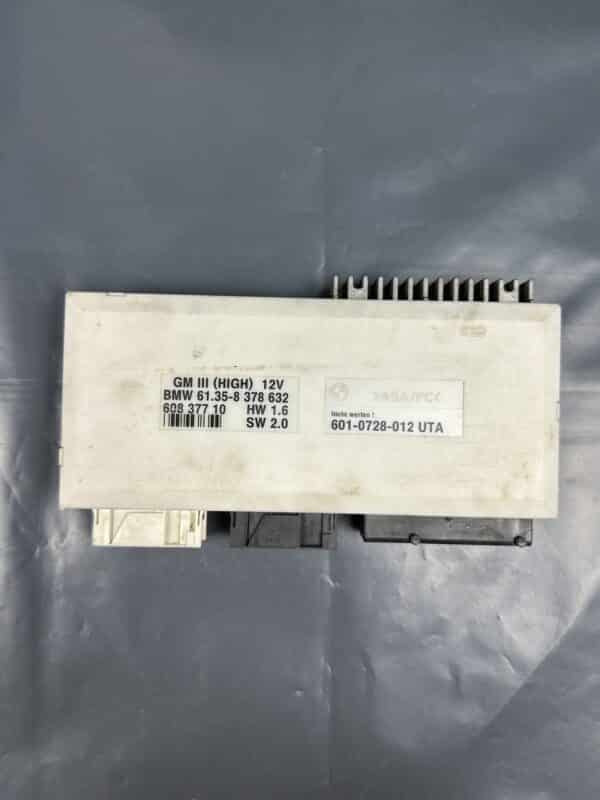


BMW E36 3-Series ABS Control Module Failure Symptoms and Repair
The ABS control module on the BMW E36 is one of the more underrated electrical failure points on this platform. It sits in a vulnerable location, handles safety-critical braking functions, and when it starts to fail, it does so in ways that are easy to misdiagnose as a wheel speed sensor or hydraulic pump issue. The ABS unit fitted to most E36 models is a Bosch 5.0 or 5.3 unit — both are prone to internal relay failure and capacitor degradation after 20-plus years of thermal cycling.
Quick Answer: What Is the E36 ABS Module and Why Does It Fail?
The ABS control module in the BMW E36 3-Series is the electronic brain that processes wheel speed sensor signals and controls brake pressure modulation during emergency stops. On vehicles from this era, internal solder joint cracking and relay contact wear are the primary failure modes. The ABS warning light illuminates, the system deactivates, and in some cases the brake pedal feels unusually firm or pulsates at low speed — none of which point obviously to the module itself without proper diagnostic scanning.
Symptoms That Brought the Car into the Workshop
A 1996 E36 328i came in with the ABS and brake warning lights permanently on. The owner had already replaced both front wheel speed sensors based on advice from a forum — no change. Brake pedal feel was normal, no noises from the hydraulic pump, and all four sensors were outputting correct signals on the oscilloscope. Classic symptom pattern of a failed ABS module rather than a sensor problem. For comparison, see BMW E36 3-Series Airbag SRS Module Failure: Symptoms and Repair.
Other typical symptoms reported by E36 owners:
- ABS warning light on with no other obvious faults
- ABS activating unnecessarily at low speeds or on dry road
- Complete ABS deactivation — brakes work but no anti-lock function
- Intermittent fault that clears itself after the car sits overnight
- Fault codes that do not match any sensor or wiring defect
Common Fault Codes for the E36 ABS Module
These codes are retrieved via BMW-specific diagnostics (INPA, DIS, or equivalent OBD tools that can read ABS subsystems on pre-OBD-II and early OBD-II E36 builds):
| Code | Meaning |
|---|---|
| ABS 1 / 1A | Front left wheel speed sensor signal fault or implausible signal |
| ABS 2 / 1B | Front right wheel speed sensor signal fault |
| ABS 3 / 1C | Rear left wheel speed sensor signal fault |
| ABS 4 / 1D | Rear right wheel speed sensor signal fault |
| ABS 11 | ABS valve relay fault — common internal module failure indicator |
| ABS 12 | ABS pump motor relay fault — internal module relay degradation |
| ABS 13 | Low voltage supply to ABS module |
| ABS 28 | Internal ECU fault — module requires replacement or rebuild |
Codes 11, 12 and 28 in particular are strong indicators of internal module failure rather than external wiring or sensor problems. If these appear alongside otherwise healthy sensor readings, focus your diagnosis on the module itself.
Diagnostic Steps Before Replacing the Module
Do not skip the basics. Even experienced workshops occasionally replace the module only to find the fault returns because of something upstream.
- Check fuse F5 (ABS fuse in the engine bay fuse box) — a blown fuse alone can mimic module failure symptoms.
- Measure battery voltage at the module connector under load — below 11.5V will trigger false codes.
- Inspect the module connector for corrosion or pushed-back pins — the 35-pin connector on Bosch 5.x units is known to develop micro-corrosion.
- Test all four wheel speed sensors individually using live data — passive sensors should show clean AC signal at wheel rotation.
- If all the above are healthy and you still have codes 11, 12 or 28, the module is the fault.
Common OEM Part Numbers for the E36 ABS Module
The correct part depends on the exact model variant and whether the car has ASC+T (traction control) or ABS-only configuration. Always cross-reference the part number stamped on the original unit before ordering. A related diagnostic guide is BMW E36 3-Series DME Engine Control Module Faults Diagnosis.
- 34521163742 — Bosch 5.0, ABS only, 4-cylinder E36 models (316i, 318i)
- 34521164038 — Bosch 5.0, ABS only, 6-cylinder E36 (320i, 323i, 325i)
- 34521164039 — Bosch 5.0, ABS only, E36 328i
- 34521164719 — Bosch 5.3, with ASC+T, E36 M3 and later 6-cylinder
- 34521163741 — Bosch 5.0 variant for early E36 1992–1994 production
- 34521182077 — Bosch 5.3 ASC+T unit, late E36 production 1997–1999
Affected Vehicles
The Bosch 5.0 and 5.3 ABS module failure affects the following vehicles:
- BMW E36 316i, 318i, 318is, 318ti — 1992 to 1999
- BMW E36 320i, 323i, 325i, 328i — 1992 to 1999
- BMW E36 M3 (3.0 and 3.2) — 1994 to 1999
- BMW E36 Compact, Touring and Convertible body variants sharing the same platform
- Some early E46 3-Series (1999–2000) used transitional Bosch 5.3 units with related failure patterns
Repair or Replace? What Makes Sense for the E36
Rebuilding the Bosch 5.0 unit is technically possible — the internal relay is available as a component and the solder joints can be reflowed. Some specialist electronics shops offer this service. However, results are inconsistent on high-mileage units where the PCB has suffered multiple heat cycles. A tested used OEM module from a low-mileage donor car is typically the more reliable path, costs less than a full rebuild service, and can be swapped in 20 minutes.
The E36 ABS module does not require coding — it is a plug-and-play replacement as long as the part number matches the original. No dealer involvement needed. This is one of the few older BMW modules where swapping a tested OEM unit is genuinely straightforward.
FAQ
Can I drive the BMW E36 with the ABS warning light on?
You can drive it, but the ABS system is inactive. Normal braking still functions, but you lose anti-lock protection. On wet or slippery roads this is a real safety risk. Get the fault diagnosed before regular driving, especially in autumn or winter conditions.
Does the E36 ABS module need coding after replacement?
No. The Bosch 5.0 and 5.3 ABS modules fitted to the E36 are plug-and-play. There is no VIN coding or dealer programming required. Match the part number from the original unit, install the replacement, clear fault codes, and test. This is significantly simpler than later BMW platforms. For additional context, read BMW E36 3-Series Instrument Cluster Faults Common Failures and Repair.
Why do my wheel speed sensors test fine but ABS codes keep returning?
Internal module faults — particularly relay failure (codes 11 and 12) — generate the same fault code prefixes as sensor faults. If all four sensors show clean live signals and wiring checks out, the fault is inside the module. Sensor replacement in this situation wastes money and time.
Where is the ABS module located on the BMW E36?
The ABS control module is mounted on the hydraulic pump and valve block assembly, located in the engine bay on the driver’s side inner wing. On most E36 variants it is accessible without removing other components. The 35-pin connector releases with a locking tab — do not force it.
Is a used OEM ABS module from another E36 safe to fit?
Yes, provided it is the correct part number variant and has been tested before sale. The E36 ABS module has no vehicle-specific coding, so a tested used unit from a donor vehicle is a legitimate and cost-effective solution. Avoid untested units from unknown sources — internal relay condition cannot be verified visually.
Find tested OEM electronic parts and modules at:
https://giantparts.eu/
Related diagnostic guides and OEM parts
- BMW E39 5-Series ABS Module Failure: Diagnostic and Repair Guide
- BMW E46 ABS Module Failure: Common Faults and Diagnostic Guide
Related available product: 1163090 BMW E36 ABS ES ECU Control Module 5WK8421 – OEM Used & Tested
Browse the category: ABS управляващи Модули за спирачната система