

BMW E39 5-Series DME Failure: Symptoms Diagnosis and Repair Guide
The DME (Digital Motor Electronics) is the primary engine control unit in the BMW E39 5-Series, responsible for managing fuel injection, ignition timing, idle control and communication with ancillary systems like the EWS immobilizer. When it fails, the car can refuse to start, run erratically or throw a cascade of unrelated fault codes that point straight back to the brain of the engine. A failed DME on an E39 is more common than most owners expect, especially on late-1990s and early-2000s examples where age, heat cycles and moisture have taken their toll on the solder joints inside.
What Exactly Is the DME on an E39?
BMW used Bosch Motronic units — primarily the MS43 and MS42 variants — in the E39 depending on the engine. The 520i and 523i typically run MS42, while the 525i, 528i and some 530i engines use MS43. The M54 engined 530i is one of the most common workshop visits for DME-related faults. The unit sits in the engine bay, usually on the right-hand inner wing, which exposes it to heat, vibration and occasional water ingress if the scuttle drain becomes blocked. That combination is a recipe for failure over 15–20 years.
Common Symptoms of a Failing BMW E39 DME
- No-start condition — engine cranks but will not fire; EWS sync lost or DME not powering relays correctly
- Random misfires — cylinder-specific or across all cylinders, not resolved by new plugs or coils
- Engine stalling at idle — especially when warm, with idle hunting before cut-out
- Multiple unrelated fault codes — codes for sensors that test fine when checked externally
- Loss of communication on OBD2 port — scan tool cannot establish contact with the DME
- Erratic fuel trims — LTFT values stuck at maximum positive or negative correction
- EWS mismatch warning — even though EWS module and keys are intact
One pattern that comes up repeatedly in workshop experience: the car drives fine for a few minutes, then cuts out at a roundabout or junction. Cool it down for 20 minutes and it starts again. That thermal sensitivity is a classic sign of a cracked solder joint inside the DME reacting to heat expansion. For comparison, see BMW E39 5-Series DME Engine Control Module Faults and Repair.
Common Fault Codes — BMW E39 DME
| Fault Code | Description |
|---|---|
| P0300 | Random / multiple cylinder misfire detected |
| P0301–P0306 | Cylinder-specific misfire (1 through 6) |
| P1624 | EWS / DME communication fault — immobilizer signal missing |
| P0601 | Internal ECU memory checksum error |
| P0605 | Internal ECU ROM error |
| P1500 | Idle speed control valve — signal implausible |
| P0170 / P0173 | Fuel trim malfunction, Bank 1 / Bank 2 |
| P0336 | Crankshaft position sensor signal — range/performance (often DME-side fault) |
P0601 and P0605 are almost definitive — if those appear alongside communication errors, the DME itself has developed an internal fault. Sensor codes alone are not enough to condemn the unit; always verify sensor wiring first.
Diagnostic Procedure — Workshop Steps
Start with a full power and ground check at the DME connector. The E39 DME draws power from fuse F10 (in the glovebox fuse block) and the main relay cluster. A weak ground at the engine bay earth straps causes more ghost faults than most people realise. Once power supply is confirmed clean:
- Connect a BMW-compatible scanner (INPA, ISTA or Autologic) — generic OBD2 is often insufficient for BMW proprietary codes
- Read all fault memories including freeze frame data
- Perform an EWS synchronisation check — confirm DME and EWS ISN codes match via dealer-level tool
- Check live data: coolant temp, TPS signal, MAF grams/sec, lambda sensor status
- If the DME cannot be read at all or intermittently drops communication, suspect internal hardware failure
- Carry out a cold-start versus warm-running comparison — note if faults worsen with engine temperature
OEM Part Numbers — BMW E39 DME
Part number matching is critical with BMW DME units. The unit must match the engine variant, gearbox type and market (different emission calibrations exist). Here are known OEM references for E39 DME modules:
- 7 514 488 — Bosch MS43, M54B25 engine (523i / 525i)
- 7 514 489 — Bosch MS43, M54B30 engine (530i)
- 7 515 451 — Bosch MS43, 530i variant (EU emission spec)
- 7 527 005 — Bosch MS42, M52TUB20 (520i)
- 7 527 007 — Bosch MS42, M52TUB28 (528i)
- 7 537 634 — Bosch MS43, 525i late production (2001–2003)
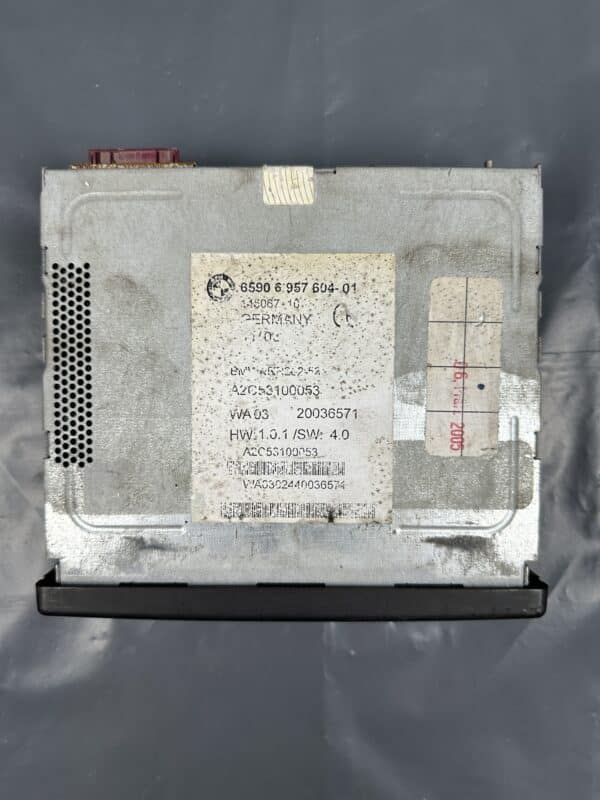
Always cross-reference against the vehicle’s VIN and the label on the DME unit itself before ordering. The last four digits on the unit label are the key identifier in the BMW parts system.
Affected Vehicles
The DME faults described here primarily affect:
- BMW E39 520i, 523i, 525i, 528i, 530i — model years 1995–2003
- Petrol engines: M52, M52TU, M54 six-cylinder family
- E39 with automatic (A5S325Z) and manual gearbox variants equally affected by internal DME failure
- Similar MS42/MS43 units used in E46 3-Series and Z3/Z4 — overlapping failure mode, different physical connector layout
The diesel-engined E39 (M57 engine) uses a separate DDE (Digital Diesel Electronics) unit by Bosch — different fault profile, not covered in this guide. A related diagnostic guide is BMW E39 5-Series ABS Module Failure: Diagnostic and Repair Guide.
Repair vs Replacement — What Makes Sense?
Electronic repair specialists can reflow solder joints and replace failed capacitors inside the DME board. For a car that is otherwise solid, this can cost less than a replacement unit. However, if the internal processor or flash memory has been corrupted — which P0601/P0605 codes suggest — board-level repair is unlikely to fully resolve the issue. A tested used OEM DME from a matching donor vehicle is often the cleaner, faster solution. The key requirement is EWS synchronisation: a replacement DME needs its ISN (Individual Serial Number) matched to the car’s EWS module, which requires BMW-specific tooling (BMW INPA + NCS Expert, or a specialist with ISTA-P access).
Frequently Asked Questions
Can I swap an E39 DME without reprogramming?
No. The BMW E39 DME is EWS-locked, meaning the ISN stored in the DME must match the EWS module in the car. Fitting a direct replacement without synchronisation will result in an immobilizer-active no-start condition. You will need either dealer-level BMW tooling or a specialist who can perform ISN matching. Some shops also offer DME cloning services where your original ISN is written into the replacement unit.
How do I know if the DME is faulty or if it is a sensor issue?
The clearest indicator is when fault codes appear for multiple unrelated sensors simultaneously — sensors that individually test fine with a multimeter. Internal checksum error codes (P0601, P0605) are also DME-specific and cannot be caused by external sensors. If the scan tool cannot establish communication with the DME even after confirmed power and ground supply, the unit itself is the likely culprit.
What causes the E39 DME to fail?
The most common causes are heat-cycle fatigue causing cracked solder joints on the main processor, water ingress from blocked scuttle drains that route moisture towards the DME mounting location, and age-related capacitor degradation on the circuit board. On high-mileage examples (200,000 km+), simple age and vibration are often enough. The Bosch MS43 units are generally more reliable than the older MS42 in this regard. For additional context, read BMW E39 ABS Module Failure: Symptoms, Codes and Repair Guide.
Is a used OEM DME safe to buy?
A tested used OEM DME from a reputable supplier is a practical and cost-effective option for the E39. The critical checks are: matching engine code, matching gearbox type, and ensuring the ISN can be adapted to your EWS. Suppliers like GiantParts source and test these units before dispatch, which significantly reduces the risk of fitting another failed module. Always confirm the part number prefix matches your application before purchasing.
Can a faulty DME damage other components?
In most cases, no — a failing DME tends to cause running problems rather than collateral damage. However, prolonged misfiring caused by erratic DME output can foul catalytic converters and oxygen sensors over time. In rare cases where the DME develops a short internally, it can affect the main relay circuit. It is worth checking fuse integrity and relay contacts if the DME has failed catastrophically rather than just degraded gradually.
Where to Find a Tested Replacement DME
Sourcing a tested OEM DME for the BMW E39 is straightforward through specialist suppliers with European OEM inventory. GiantParts.eu stocks tested used OEM electronic modules including DME units for the E39 range, matched by part number with worldwide shipping. Each unit is tested before dispatch, which matters — an untested unit from an unknown salvage source may have the same fault as the one you are replacing.
Find tested OEM electronic parts and modules at:
https://giantparts.eu/