

BMW E39 5-Series EWS Immobilizer Faults: Symptoms and Repair
The EWS (Elektronische Wegfahrsperre) immobilizer on the BMW E39 5-Series is a rolling-code security system that links the ignition key, the EWS control unit, and the DME engine management module. When it fails, the car simply will not start — the DME receives no release signal and cuts fuel injection. This is one of the most misdiagnosed faults on E39s, regularly confused with a dead battery, failed starter, or fuel pump issue.
Quick Answer: What Is the EWS and Why Does It Fail?
The EWS3 module fitted to the E39 (1995–2004) communicates with a transponder coil around the ignition barrel. On every key turn, it generates a new release code and sends it to the DME. If the handshake fails — due to a faulty EWS unit, damaged transponder ring, lost synchronization between EWS and DME, or a worn key chip — the engine will crank but never fire. On E39s built before late 1998, the earlier EWS2 system was used, which has slightly different failure characteristics but the same root-cause categories.
What Are the Symptoms of EWS Failure on the E39?
The most obvious sign is an engine that cranks perfectly but refuses to start. The starter motor spins, compression is normal, fuel pressure checks out — but nothing happens. What many owners miss is the EWS warning lamp on the instrument cluster: a small car-with-key icon that should flash briefly and then go out. If it stays on or flashes continuously after the key is turned, the EWS loop has not closed correctly.
Other symptoms worth noting:
- Engine starts briefly (2–3 seconds) then cuts out immediately — classic EWS timeout behaviour
- Intermittent no-start that disappears after a second attempt — early-stage transponder coil degradation
- Car starts fine with one key but not another — individual key transponder failure rather than the module itself
- Total no-start after battery replacement or flat battery — EWS/DME synchronization lost
- Fault codes stored in DME pointing to EWS communication failure
Common Error Codes — EWS Faults on BMW E39
| Fault Code | Description |
|---|---|
| DME fault 59 (0x3B) | EWS tampering detected / no valid EWS signal received |
| DME fault 60 (0x3C) | EWS/DME rolling code mismatch — synchronization lost |
| EWS fault 1 | No communication with DME via CAN/K-line |
| EWS fault 2 | Transponder coil signal absent or too weak |
| EWS fault 4 | Key not recognized — transponder chip damaged or wrong key |
| EWS fault 8 | Internal EWS module fault — hardware failure |
Reading these codes requires BMW-compatible diagnostics — INPA, DIS, or a professional scanner with BMW EWS access. Generic OBD tools will not reach the EWS module directly. For comparison, see BMW E46 3-Series EWS Immobilizer Faults: Symptoms and Repair.
Root Causes: What Actually Goes Wrong
In a typical workshop scenario with an E39 that cranks but won’t start, here are the failure points ordered by how often they actually appear:
1. Transponder coil failure. The ring antenna around the ignition barrel degrades over time, especially on high-mileage cars. It’s a surprisingly cheap part but gets overlooked. Check resistance across the coil terminals — should be around 1.5–2.5 ohms. Open circuit or very high resistance means a failed coil.
2. EWS module capacitor failure. The EWS3 unit is mounted behind the dashboard on the E39. The internal capacitors age, causing the module to lose its memory or fail to hold synchronization. This is particularly common on cars that sit unused for long periods.
3. EWS/DME synchronization loss. If someone has swapped the DME or EWS module without properly re-syncing the two units, or if a dead battery caused a reset, the rolling code sequence becomes misaligned. The fix requires BMW dealer or specialist equipment to re-synchronize.
4. Key transponder wear. The key chips on 20-year-old E39 keys do fail. Test with a known-good spare key first before condemning the module. A related diagnostic guide is BMW E90 3-Series EWS Immobilizer Faults Common Symptoms and Repair.
Common OEM Part Numbers — BMW E39 EWS
- 61358373946 — EWS3.3 control unit, E39 525i/528i/530i (1998–2003)
- 61358374434 — EWS3.2 module variant, E39 520i/523i (1996–1999)
- 61351393541 — Transponder ring/coil for E39 ignition barrel
- 61351387016 — EWS2 module, early E39 (1995–1997)
- 66126988935 — Remote key with transponder chip, E39 compatible
- 61358371876 — EWS3 module, E39 M5 / 540i variant
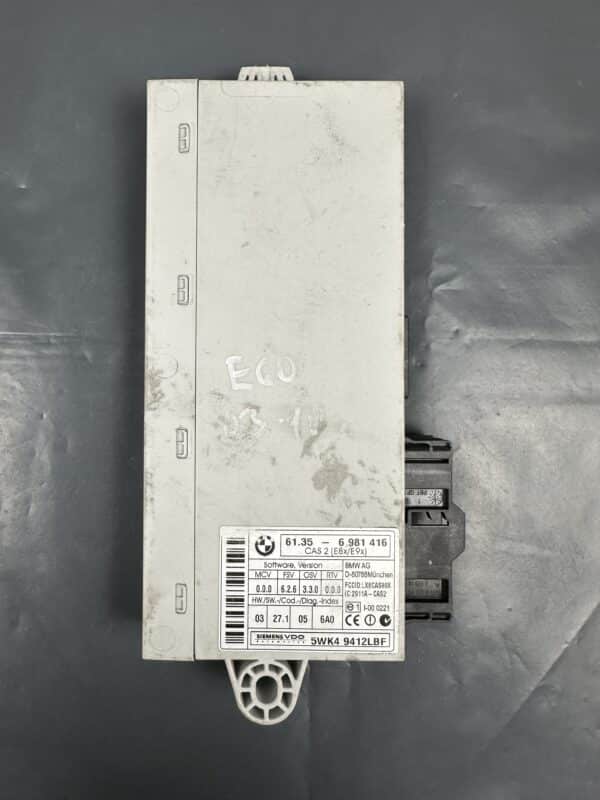
Always cross-reference the part number stamped on your existing EWS module before ordering. The number is on a label on the unit itself. Using a mismatched EWS requires a full re-synchronization with the DME — this is not plug-and-play.
Affected Vehicles
The EWS3 system was used across a wide range of BMW models from the mid-1990s through the early 2000s. E39 owners are not alone in dealing with this:
- BMW E39 5-Series — all engines, 1995–2004 (EWS2 on early cars, EWS3 from 1998 onward)
- BMW E38 7-Series — 1994–2001, same EWS architecture
- BMW E46 3-Series — 1998–2005, EWS3 and later EWS3.3
- BMW E53 X5 — 2000–2006, EWS3.3
- BMW E83 X3 — 2003–2006, similar EWS3.3 generation
- BMW Z3 and Z4 (E85) early production — EWS3 fitted
Repair vs Replacement: What Makes Sense on an E39?
The EWS module itself is not repairable by most workshops — it’s an encapsulated unit and the internal firmware is security-locked. If the module has definitively failed, replacement with a tested used OEM unit is the most cost-effective route. The key is matching the exact part number and then having the EWS and DME re-synchronized by someone with the right BMW diagnostic software. Skipping the sync step means the new unit will also refuse to start the car.
Transponder coil replacements are cheap and worth doing as a first step before condemning the EWS module — many shops skip this and go straight to replacing the control unit unnecessarily.
FAQ
Why does my BMW E39 crank but not start after a flat battery?
A deeply discharged or disconnected battery can sometimes cause the EWS and DME to lose their rolling code synchronization. The engine will crank normally but the DME will not receive a valid release signal from the EWS. This typically needs to be resolved with BMW diagnostic equipment to re-sync the two modules — it does not fix itself by simply recharging the battery. For additional context, read BMW E38 7-Series EWS Immobilizer Faults Symptoms and Repair.
Can I replace the EWS module myself on an E39?
Physically removing and fitting the module is straightforward — it is located behind the instrument cluster area on most E39s. However, a used replacement unit must be re-synchronized with the existing DME before the car will start. This step requires specialist BMW software such as INPA with the correct EWS programming scripts, or a BMW dealer tool. Without synchronization, the car will not start regardless of which EWS module is fitted.
How do I know if my EWS or my DME is at fault?
The fastest way is to read fault codes from both modules separately. EWS-specific faults pointing to internal hardware failure suggest the EWS unit. DME faults referencing EWS communication (codes 59/60) without corresponding EWS internal faults often point to a wiring or synchronization issue rather than a dead module. Testing the transponder coil resistance and checking the K-line wiring between EWS and DME should come before condemning either control unit.
What is the difference between EWS2 and EWS3 on the E39?
EWS2 was fitted to E39s produced roughly from 1995 to mid-1997. It uses a fixed-code system and is considered less secure. EWS3 (and its variants 3.2 and 3.3) introduced rolling-code encryption and was fitted from late 1997 onward. The modules are not interchangeable — if you are sourcing a replacement, you must match the generation as well as the specific part number to your car’s production date and engine variant.
Is a used OEM EWS module safe to buy for an E39?
Yes, provided it is sourced from a reputable supplier who tests the unit before shipping and can confirm the exact part number match. A tested used OEM EWS module from a donor car is the standard workshop solution — new replacement units are expensive and often harder to source. The unit must still be synchronized to your DME after fitting, so factor that into the repair cost when planning the job.
Find tested OEM electronic parts and modules at:
https://giantparts.eu/
Related diagnostic guides and OEM parts
- Audi A4 B6 Immobilizer and EWS Faults: Diagnosis and Repair Guide
- BMW E39 5-Series ABS Module Failure: Diagnostic and Repair Guide
Browse the category: Ignition Lock, Key & Immobilizer Control Modules