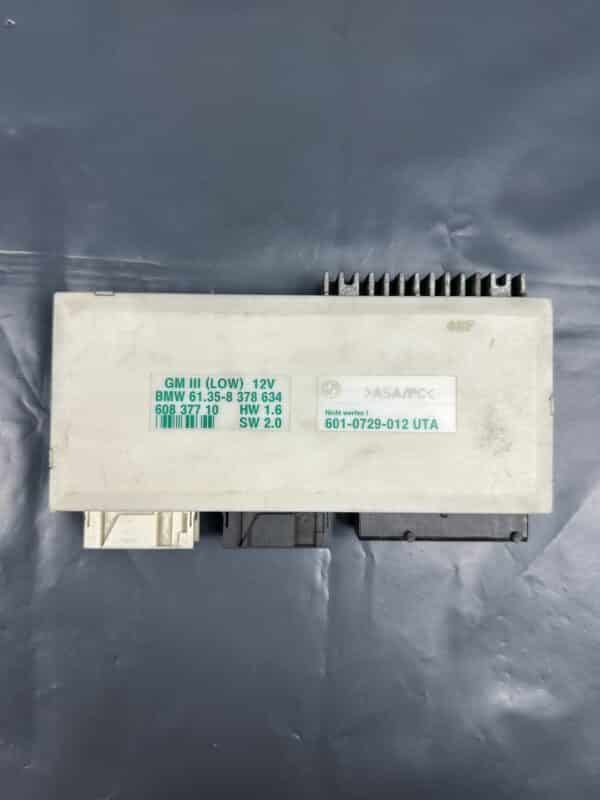
Mercedes W140 S-Class Central Locking Control Module Diagnosis
The central locking control module in the Mercedes W140 S-Class manages the vacuum or electrohydraulic locking system across all doors, the boot lid and the fuel cap cover. When it fails, the result is rarely a total and immediate shutdown — it usually starts with one door responding slowly, then unpredictable locking behaviour, and eventually a system that stops responding altogether. The module itself is a body electronics unit that receives inputs from the door switches and key barrel, then coordinates actuation. Unlike later CAN-based systems, the W140 uses a relatively direct wiring architecture, which makes diagnosis more accessible but also means connector corrosion and ground faults are common causes.
How the W140 Central Locking System Works
The W140 uses a vacuum-assisted central locking system on earlier models (pre-facelift, up to approximately 1994) and transitioned to electrohydraulic actuators on later variants. The control module sits in the boot area or behind the driver’s side kick panel depending on the production year. It interprets lock and unlock signals from the door key barrels, the interior switches, and the infrared remote receiver (fitted to later W140 models with remote locking). It then sends timed voltage pulses to each actuator.
The infrared remote module is separate from the central locking controller on most W140 variants, so remote locking failure and manual lock failure can point to different components. This distinction matters during diagnosis — ruling out the remote receiver first saves time.
Typical Failure Symptoms
- One or more doors fail to lock or unlock while others respond normally
- All doors lock but do not unlock, or vice versa
- Intermittent full system lock-out, often triggered by temperature change
- Doors unlock spontaneously while driving — usually a sign of moisture in the module
- Clicking or cycling noise from the boot actuator with no corresponding door movement
- Remote locking stops working while manual key operation still functions
- System works normally when cold but fails when the interior is warm
The last symptom — heat-sensitive failure — is a strong indicator of a failing solder joint or a capacitor inside the module. In workshop conditions, applying gentle heat to the module casing often reproduces the fault and confirms the unit rather than the wiring. For comparison, see How a Failing Mercedes W140 S-Class ABS Module Triggers Brake Warnings.
Съответни кодове за неизправности
The W140 predates the widespread use of detailed body electronics fault logging. Star Diagnosis and older MB diagnostic tools (such as the HHT or early DAS versions) can read the following general codes related to the central locking system:
| Code / Description | Значение |
|---|---|
| B1001 / Door module communication fault | Signal interruption between locking module and a door unit |
| B1045 / Central locking actuator circuit | Open or short circuit to one of the locking actuators |
| B1072 / Lock signal implausible | Conflicting lock state — module receiving lock and unlock simultaneously |
| No fault stored, system inactive | Module has lost supply voltage or ground — check fuse and earth strap first |
Many W140 central locking faults produce no stored code. The module does not always log internal failures, especially on pre-facelift units. A clean fault memory does not rule out a defective module.
OEM номера на части
The central locking control module varies by production year, body style (standard wheelbase vs long wheelbase) and equipment level. The following numbers are associated with W140 production from 1991 to 1999:
- 140 820 05 26 — Early W140, standard wheelbase, vacuum system
- 140 820 08 26 — Later standard wheelbase, electrohydraulic variant
- 140 820 14 26 — Long wheelbase (W140 V140 platform), later production
- 140 820 21 26 — Revised controller, facelift models from 1994 onward
- 140 820 27 26 — Final production variant with updated infrared receiver interface
Always cross-reference the number stamped on the original module before ordering. Fitting a module from a different variant can cause partial function — some doors may respond while others do not, because actuator timing sequences differ between locking system generations. A related diagnostic guide is Mercedes W140 S-Class Transmission Control Unit Coding and Replacement.
Affected Vehicles and Variants
The W140 S-Class was produced from 1991 to 1999. Central locking module failures appear across the full production run but are most commonly reported on vehicles from 1993 to 1997 — the period before the electrohydraulic system was fully standardised. Affected variants include:
- W140 300 SE / 300 SEL (1991–1993)
- W140 S280, S320, S350 (1994–1999)
- W140 S420, S500, S600 (all years)
- C140 Coupé (SEC/CL) — shares the same central locking module family
The C140 CL-Class coupe uses related but not always interchangeable modules. Confirm the part number from the original unit before assuming cross-compatibility.
Diagnosis Before Replacement
Before condemning the module, check these points in order:
- Locate fuse 22 or 29 (depending on year) in the driver-side fuse panel — a blown fuse causes total system inactivity and is often misread as a module fault.
- Check the earth strap from the module casing to the body. Resistance above 0.5 ohms on this path causes intermittent and temperature-sensitive failures.
- Disconnect the actuator connectors individually and measure resistance across each actuator. An open-circuit actuator can pull enough current to stress the module output stage.
- Inspect the module connector for corrosion, particularly the ground pin and the actuator output pins. Light corrosion on these pins is common on high-mileage W140s and causes exactly the kind of intermittent faults described above.
- If the fault only affects remote locking, test the infrared receiver separately before replacing the main module.
Replacement and Used OEM Advice
The W140 central locking module does not require coding on most variants — it is a plug-and-play replacement once the correct OEM number is confirmed. Facelift models with infrared remote function may need the remote handsets resynchronised after module replacement, but this does not require dealer-level programming. A tested used OEM unit from a matching vehicle is a practical and cost-effective solution. Confirm the module is from the same locking system generation (vacuum vs electrohydraulic) and the same wheelbase variant to avoid partial function after fitting.
Често задавани въпроси
Can a faulty central locking module drain the W140 battery overnight?
Yes, in some cases. If the module enters a fault state and continuously attempts to actuate the locking system, it draws current even with the ignition off. This is more common when an actuator has failed and creates a constant load on the module output. If the W140 has an unexplained battery drain, disconnect the central locking module and measure current draw — if drain drops significantly, the module or an actuator is likely responsible.
Why do only some doors lock when the system is activated?
This usually means the module output for the affected door circuit has failed internally, or the actuator on that door has developed a high-resistance fault. Test each actuator individually before replacing the module. If all actuators measure within specification and one door still does not respond, the module output stage for that channel is the likely cause. For additional context, read Mercedes W140 S-Class Climate Control Unit Faults and Repair.
Does the replacement module need to be coded to the W140?
On most W140 variants the central locking module is not VIN-coded and does not require dealer programming. Plug it in with the correct OEM number and the system should operate immediately. If the vehicle has an optional alarm or infrared remote system, the remote handsets may need resynchronisation — this is usually done by holding the lock button for several seconds near the receiver aperture in the door frame.
Is a remanufactured unit a reliable option for the W140?
Remanufactured units vary considerably in quality. For a vehicle of this age, a tested used OEM unit from a matching donor car with confirmed low mileage is generally more reliable than a cheap remanufactured module where repair quality is unknown. Verify the OEM number and confirm the unit has been bench-tested before fitting.
Can water damage cause the W140 central locking module to fail?
Yes. The module is mounted in areas susceptible to water ingress — particularly the boot on some build variants, where a failing seal allows moisture to reach the module casing. Water causes corrosion on the PCB and connector pins, resulting in exactly the intermittent and heat-sensitive symptoms described above. If there are signs of moisture in the boot or at the module location, address the ingress source before fitting a replacement unit.
Намерете проверени оригинални електронни части и модули на адрес:
https://giantparts.eu/
Свързани диагностични ръководства и оригинални резервни части
- Mercedes W140 S-Class EIS Ignition Switch Module Faults Guide
- Mercedes W140 Missing Display Segments and Fuel Gauge Errors
Разгледайте категорията: Модули за централно заключване и вакуум