

What Happens When the Mercedes W211 Transmission Control Unit Fails
The Mercedes W211 E-Class uses a dedicated transmission control unit (TCU) — often referred to as the EGS module — to manage all shift logic in the 7G-Tronic or 5-speed automatic gearbox. When this module malfunctions, the gearbox typically enters a fixed emergency gear or refuses to shift at all. The problem is not always a mechanical gearbox failure; in many W211 cases the transmission hardware is perfectly intact while the control electronics are the root cause.
How the W211 TCU Works
The EGS module on the W211 communicates continuously with the engine management system and the ESP controller over the CAN bus. It monitors selector position, vehicle speed, engine load, oil temperature and driver input simultaneously. Based on this data it controls the hydraulic solenoids inside the 722.6 or 722.9 gearbox. A healthy TCU delivers smooth, imperceptible gear changes. A failing one introduces delays, jerks, or locks the transmission in one ratio as a self-protection measure.
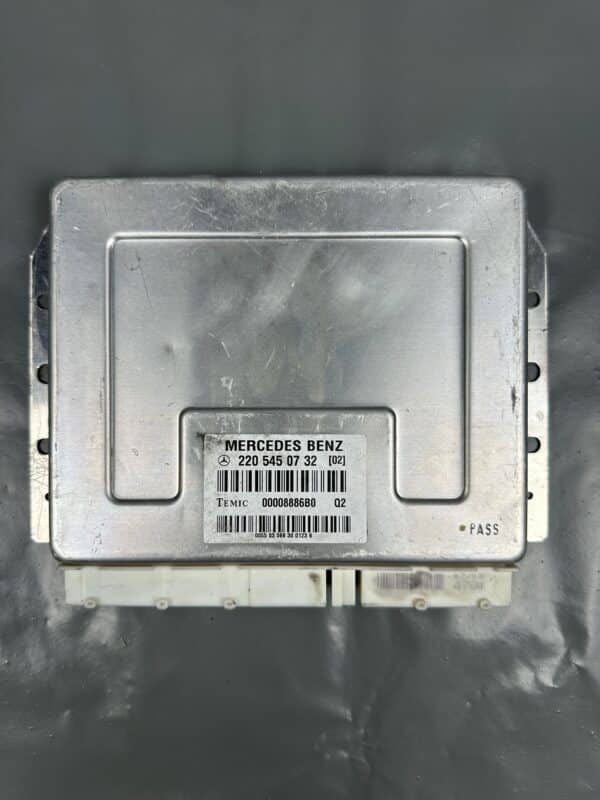
The TCU is mounted either directly on the gearbox body (722.9 mechatronic integration) or separately in the engine bay or footwell area depending on the model year and gearbox variant. Early W211 units with the 722.6 gearbox have a standalone external module. Later 722.9 units integrate the control electronics into the valve body assembly, which changes the replacement and repair approach entirely.
Common Failure Symptoms
- Harsh or delayed gear shifts — the gearbox clunks between gears, especially at low speed or during kickdown
- Limp mode / emergency program — transmission locks in third or fourth gear, acceleration is severely limited
- No drive at all — selector shows D but no forward drive is available
- Gear selector display error — the COMAND or instrument cluster shows no current gear or permanent dashes
- Slipping without driver input — unexpected downshifts or rev spikes under light load
- Fault lights — transmission warning, ESP warning or general malfunction lamp illuminates
One pattern worth noting: if the car drives normally on a cold start but develops rough shifting once the gearbox warms up, this points toward heat-related failure in the TCU electronics or internal solenoid data corruption. This is different from a purely mechanical solenoid fault and is one reason a scan tool reading should always precede any parts replacement. For comparison, see Mercedes W211 E-Class Transmission Control Unit Common Faults.
Relevant Fault Codes
The following codes are commonly found in W211 transmission control unit faults. These may appear as EGS-side codes during a full system scan with a Mercedes-capable diagnostic tool such as STAR Diagnosis or iCarsoft MB II.
| Fault Code | Description |
|---|---|
| P0700 | Transmission control system malfunction — general TCU fault signal to ECM |
| P0715 | Input/turbine speed sensor circuit malfunction — signal loss affecting shift logic |
| P0730 | Incorrect gear ratio detected — mismatch between expected and actual shift |
| P0750 | Shift solenoid A malfunction — electrical or mechanical solenoid issue |
| P0793 | Intermediate shaft speed sensor — no signal received by TCU |
| C1400 / 1401 | EGS internal fault — module self-test failure, often requires module replacement |
Always clear codes after addressing the root cause. If C1400 or a related EGS internal fault returns immediately after clearing, the module itself has failed rather than a sensor or wiring harness issue.
Why the W211 TCU Fails
Moisture ingress is responsible for a significant portion of external TCU failures on early W211 models. The module can sit in a location exposed to condensation or water entry through a deteriorated bulkhead grommet. Internally, capacitor failure and solder joint cracking under thermal cycling are the most frequent electronic causes. Gearbox oil contamination reaching the mechatronic connector is a separate but common path on 722.9 units.
High mileage vehicles — typically those above 180,000 km — are statistically more likely to exhibit TCU faults alongside worn solenoids. In these cases, replacing only the TCU without inspecting the solenoid block may not produce a durable repair. A workshop should confirm solenoid resistance values before committing to a module-only fix.
OEM Part Numbers to Reference
The correct TCU part number depends on the gearbox variant, engine and production year. Using the wrong number risks incompatibility or a module that requires different software. Always verify against the vehicle identification plate and the original module label. The following numbers cover common W211 variants: A related diagnostic guide is What Happens When the Mercedes W211 SAM Module Gets Water Inside.
- A 002 545 40 32 — 722.6 external EGS module, early W211 E220 / E270 CDI
- A 002 545 86 32 — 722.6 EGS, W211 E320 / E500 petrol variants
- A 211 545 06 32 — 722.9 mechatronic control unit, W211 post-2004 facelifts
- A 211 545 09 32 — 722.9 variant for diesel-equipped W211 with DPF
- A 002 545 45 32 — later 722.6 EGS, W211 AMG-line applications
Matching the exact OEM number is strongly recommended. Variants differ in internal calibration tables, software revisions and CAN message structure. A module from a different ratio variant may fit physically but shift incorrectly or produce persistent fault codes.
Affected Vehicle Range
The W211 E-Class was produced from 2002 to 2009. All automatic variants are potentially affected, though the failure mechanism differs between the 722.6 (external module) and the 722.9 mechatronic unit. The 722.9 became standard from approximately model year 2004 on most markets. Diesel variants — E220 CDI, E270 CDI, E320 CDI — and petrol variants — E240, E280, E320, E500 — all use automatic transmissions with TCU electronics subject to the same failure modes. The E55 AMG uses its own adapted EGS variant and the part numbers differ accordingly.
Replacement and Coding
A replacement external TCU for the 722.6 gearbox generally requires adaptation using Mercedes STAR Diagnosis or equivalent. The module must be matched to the vehicle’s VIN data and the gearbox selector calibration must be reset. Simply swapping a used unit without performing adaptation often results in incorrect shift points or persistent stored faults.
For 722.9 mechatronic units the situation is more complex. The control electronics are integrated with the hydraulic valve body and cannot be separated in the field. The complete mechatronic assembly must be replaced, and a full adaptation procedure including selector learning and valve body calibration must follow. Professional dealer or specialist tools are required. A used OEM mechatronic from the same gearbox family with the matching part number can be a cost-effective solution provided it has been tested before installation.
Frequently Asked Questions
Can a faulty W211 TCU damage the gearbox mechanically?
Indirectly, yes. A TCU that commands incorrect solenoid duty cycles can cause harsh engagements that accelerate clutch pack wear over time. If limp mode activates quickly the mechanical damage is usually limited. Persistent slipping caused by incorrect pressure commands is the more damaging scenario and should be diagnosed promptly. For additional context, read Mercedes W211 E-Class ABS Module Failure: Common Faults and Repair Guide.
Will disconnecting the battery reset the TCU and fix the problem?
A battery disconnect clears adaptive shift data and may temporarily suppress a stored fault. However, if the underlying fault is a hardware failure within the TCU or a wiring fault, the problem will return within a short driving distance. Resetting alone is not a repair and should only be used as a diagnostic step to check whether a fault is intermittent or permanent.
Is a used OEM TCU a safe replacement choice?
A tested used OEM module from the same gearbox variant and with the matching part number is a practical option for many owners. The key requirements are correct part number matching and proper adaptation after fitting. Avoid modules from unknown sources where operating history and testing status cannot be confirmed. Suppliers like GiantParts test modules before sale, which reduces the risk of fitting a second faulty unit.
How do I confirm the TCU is faulty rather than a solenoid or sensor?
Start with a full system scan using a Mercedes-capable tool. Solenoid faults with specific cylinder identification (e.g. shift solenoid A or B) suggest the solenoid itself. Internal TCU self-test faults or codes indicating module communication failure point directly to the TCU. Verify wiring harness continuity and solenoid resistance values before replacing the control unit. This sequence avoids unnecessary module replacement when the actual fault is upstream.
Does the W211 TCU need to be coded to the VIN after replacement?
Yes, for the 722.6 external module, basic adaptation and selector calibration are required using Mercedes STAR Diagnosis or a compatible tool. The module does not need VIN encoding in the same way an ECU does, but it must complete its adaptation procedure to learn the gearbox parameters. Without this, shift quality will be poor and fault codes may reappear despite a mechanically sound installation.
Find tested OEM electronic parts and modules at:
https://giantparts.eu/
Related diagnostic guides and OEM parts
- Mercedes W211 E-Class Instrument Cluster Faults Diagnosis and Repair
- Mercedes W211 E-Class SAM Module Faults Diagnosis and Repair Guide
Related available product: A0325451432 Mercedes-Benz W211 Automatic Transmission ECU Module – OEM Used & Tested
Browse the category: Модули за управление на автоматична трансмисия (ECU и TCM)