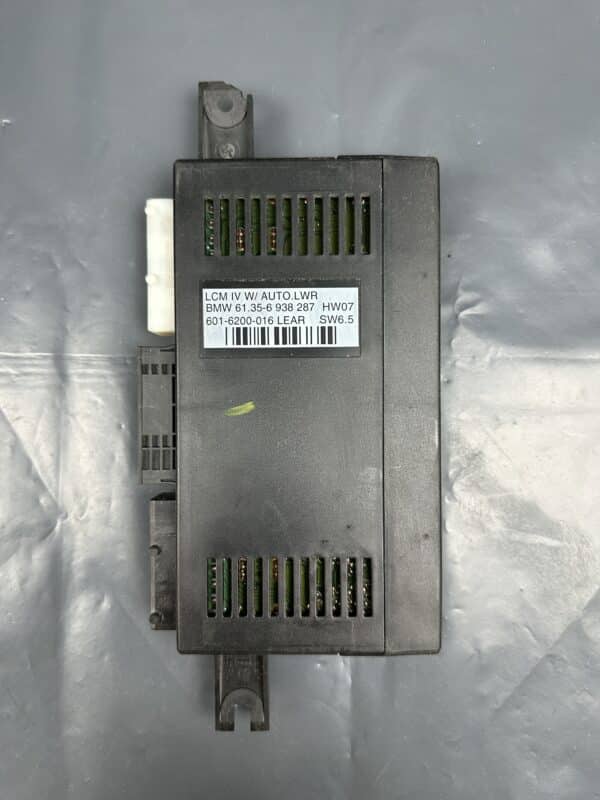


BMW E60 5-Series CAS Module Failure: Symptoms and Repair Guide
The CAS module — Car Access System — is the heart of the E60’s immobilizer, key recognition and start authorization chain. When it fails, the car simply refuses to start, the key stops being recognized, or you get a dead dash with no response at all. It is not a component most owners think about until they are stranded in a car park at 7am wondering why the engine cranks but never fires.
What Does the CAS Module Actually Do?
On the BMW E60 5-Series (2003–2010), the CAS3 or CAS3+ module handles transponder communication with the remote key, grants engine start permission via the DME/DDE, controls the EWS immobilizer loop, and manages the starter relay. It also stores the vehicle’s VIN binding — which is exactly why swapping one in without proper coding causes headaches. The CAS communicates over K-CAN and PT-CAN, so a dead or corrupted module can take several other control units with it in terms of communication faults.
Common Symptoms of a Failing CAS on the E60
- Key inserted but no response — dash stays dark, no welcome sequence
- Engine cranks normally but will not start (immobilizer active, no injection pulse)
- Remote locking works intermittently or stops altogether
- Message on iDrive: “Drivetrain: Drive moderately” or “Key not recognized”
- Random no-start that clears after leaving the car for 10–20 minutes
- Battery drain — a faulty CAS sometimes fails to enter sleep mode properly
- Multiple unrelated fault codes appearing after a single no-start event
That last point catches a lot of people out. A failing CAS can dump ten or fifteen fault codes from ABS, DSC, EGS and the instrument cluster all at once — not because those modules are broken, but because the CAS disrupted the bus wakeup sequence. Clear the codes, fix the CAS, and they rarely return. For comparison, see BMW E60 5-Series CAS Module Failure: Common Faults and Repair.
Common Error Codes
| Code | Description |
|---|---|
| A001F | CAS: no communication with DME/DDE |
| A0094 | CAS: transponder fault — key not recognized |
| A0096 | CAS: internal EEPROM fault |
| A009A | CAS: immobilizer active, start blocked |
| A00A2 | CAS: CAN bus message missing (PT-CAN) |
| 480A | DME: no start release from CAS |
| 4815 | DME: EWS/CAS communication timeout |
These codes are best read with BMW-specific diagnostics — ISTA+, INPA or a quality third-party tool like MHD or Carly. Generic OBD readers will often miss CAS-specific codes entirely.
Why Does the CAS Fail on the E60?
The most frequent hardware cause is moisture ingress. The CAS on the E60 sits in the footwell area, and water leaks from the windscreen seal, sunroof drains or the HVAC plenum can reach it over time. Corroded PCB traces, failed capacitors, or a blown EEPROM chip are the typical post-mortem findings. On higher-mileage cars produced before 2006, the solder joints on the main processor can also crack — a known weak point on CAS3 hardware revisions from that era.
Voltage spikes from jump-starting with a charger set too high are another cause. The CAS is not well-protected against overvoltage, and more than a few have been killed by well-meaning roadside assistance.
Diagnostic Steps Before Replacing
- Connect BMW ISTA+ or INPA and read all control units, not just the CAS.
- Check supply voltage at the CAS connector — should be stable 12V with ignition on. Low voltage from a tired battery causes false CAS faults regularly.
- Inspect the CAS connector and surrounding footwell area for water damage or corrosion.
- Try a known-good coded key if available — rules out a simple key fault.
- Test CAN bus integrity — a scope or ISTA bus check will show if PT-CAN is corrupted.
If you confirm the CAS itself is faulty, you have two options: ECU repair (soldering, EEPROM replacement — specialist job) or a tested used OEM unit with proper coding. In most cases, a matched tested OEM unit is the faster and more reliable path.
Common OEM Part Numbers
| OEM Part Number | Application |
|---|---|
| 61.35-6 948 998 | CAS3 — E60 525i/530i, petrol, up to 09/2006 |
| 61.35-6 986 484 | CAS3 — E60 525i/530i, revised PCB from 10/2006 |
| 61.35-6 948 999 | CAS3 — E60 520d/525d, diesel variants, early |
| 61.35-6 964 499 | CAS3+ — E60 530d/535d, late production |
| 61.35-6 940 645 | CAS3+ — E60 M5 V10 (S85 engine) |
Always cross-reference your VIN before ordering — the CAS hardware level must match the vehicle’s production date and engine variant. Part number alone is not always sufficient; the software level matters too. Suppliers like GiantParts source units from donor vehicles and can help match by VIN. A related diagnostic guide is BMW E60 5-Series CAS Module Failure: Symptoms and Repair Guide.
Affected Vehicles
The CAS3 and CAS3+ are shared across the entire E6x platform:
- BMW E60 5-Series Saloon, 2003–2010 (520i to M5)
- BMW E61 5-Series Touring, 2004–2010
- BMW E63/E64 6-Series Coupé and Convertible, 2004–2010
- BMW E65/E66 7-Series, later CAS3 variants from around 2005
- BMW E70 X5 (2007–2010, early build dates)
- BMW E83 X3 (late facelift, 2006–2010)
If you are working on any of these platforms, the diagnosis and coding procedure is broadly the same, though part numbers will differ by variant.
Repair vs Replacement — What Makes Sense?
CAS repair is possible if the fault is isolated to a failed capacitor or corroded trace. Several specialists offer EEPROM reads and rewriting, which preserves the VIN data and avoids recoding. However, if the processor itself is damaged or the module took a voltage spike, repair success rates drop significantly. A tested used OEM unit with confirmed matching VIN data — or one coded by a BMW specialist — is typically £80–£180 fitted versus £300+ for a new unit from BMW. On a 2005 E60, that decision usually makes itself.
FAQ
Can I replace the BMW E60 CAS module myself?
Physically swapping the unit is straightforward — it is a small box secured by two screws in the footwell. The challenge is coding: the replacement CAS must be programmed to the vehicle’s VIN, matched to the DME/DDE, and all keys must be recoded. Without BMW ISTA+ and the appropriate access level, this is not a DIY job. Most independent workshops with BMW diagnostic capability can handle it.
Will the E60 start at all with a faulty CAS?
In most failure modes, no. The CAS must authorize the start signal to the DME/DDE. If it cannot do that — whether due to hardware failure, corrupted EEPROM or communication loss — the engine will crank but not fire. Some partial failures cause intermittent no-starts that can mislead diagnosis for weeks before becoming permanent. For additional context, read BMW E60 5-Series DME Failure: Common Faults and Diagnostic Guide.
How do I tell if the CAS or the key transponder is at fault?
Try a second coded key if you have one. If the second key starts the car reliably, the first key’s transponder or battery is likely the issue, not the CAS. If neither key works and fault codes confirm no transponder communication, the CAS itself is the prime suspect. A dead key battery is actually the most common cause of apparent CAS faults — worth checking first.
What is the difference between CAS3 and CAS3+?
CAS3+ is a revised hardware generation introduced on E60 models from approximately late 2006. It has improved software security and different EEPROM architecture. The units are not interchangeable without full recoding, and some later DME versions require CAS3+ specifically. Always confirm which hardware generation your car requires before sourcing a replacement.
Is a used OEM CAS module safe to buy?
Yes, provided it is sourced from a reputable supplier who tests the unit and can confirm the hardware version. A used CAS is not plug-and-play — it needs VIN matching and key recoding regardless of source. What matters is that the module itself is electrically healthy. Tested OEM units from European donor cars are a well-proven option at a fraction of new part cost, and GiantParts ships worldwide with part number matching support.
Find tested OEM electronic parts and modules at:
https://giantparts.eu/