

Mercedes W219 CLS-Class Xenon Lighting Control Module Faults Guide
The xenon lighting control module on the Mercedes W219 CLS-Class is one of those components that fails quietly at first — a flicker here, a slow warm-up there — until one morning you are left with one headlight completely dark. The Xenon ballast and its associated control electronics are known weak points on CLS models built between 2004 and 2010, and the fault can come from the ballast unit itself, the igniter, or the LWR (Leuchtweitenregulierung) levelling control module that communicates over the CAN bus.
Replacing the wrong component is expensive. This guide covers how to properly identify which part of the xenon system has failed, which fault codes point where, and what OEM part numbers to source.
Quick Answer — What Is the Xenon Control Module Fault on the W219 CLS?
The xenon lighting control module (ballast) on the Mercedes W219 CLS manages the high-voltage ignition and current regulation for the D2S discharge bulbs. When it fails, the affected headlight either does not ignite, flickers intermittently, or produces a noticeably yellow/dim output instead of the characteristic white arc. Most failures are caused by internal capacitor degradation or moisture ingress into the ballast housing, not by bulb failure alone. For comparison, see Mercedes W219 CLS-Class Instrument Cluster Faults Diagnosis and Repair.
Symptoms That Brought This Car Into the Workshop
A 2006 CLS 350 came in with the owner reporting the nearside headlight had been flickering for about three weeks before going completely dark overnight. The car had 148,000 km on it — typical mileage for this generation. A quick visual confirmed the bulb was intact. Connecting a Star Diagnosis (XENTRY) scanner immediately showed stored faults in the front SAM and the front-left headlight circuit.
- Headlight does not illuminate at all, or takes 30+ seconds to strike an arc
- Visible flickering or cycling on/off at idle or low speed
- One side appears noticeably dimmer or yellow compared to the other
- Warning lamp on dashboard: headlight failure or general lamp fault
- LWR levelling motor runs continuously or does not respond
- Fault codes logged in SAM front module or headlight control unit
Common Error Codes — W219 CLS Xenon System
| Fault Code | Description |
|---|---|
| B1070 | Left xenon headlight — no communication with ballast control unit |
| B1071 | Right xenon headlight — ballast fault, circuit open or short |
| B1085 | Headlight range adjustment (LWR) — left side, position sensor signal implausible |
| B1086 | Headlight range adjustment (LWR) — right side, actuator fault |
| B1336 | Xenon igniter — no ignition voltage detected |
| C1530 | Front SAM — xenon headlight supply voltage out of range |
| U0155 | Lost communication with instrument panel cluster (cascading from lighting CAN fault) |
Root Causes: Ballast, Igniter or LWR Module?
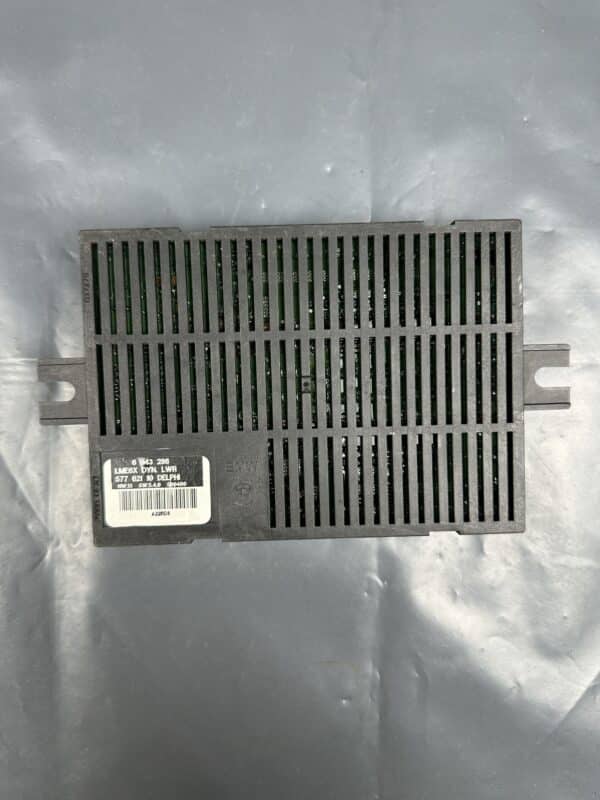
On the W219 the xenon system has three main serviceable components: the ballast (Steuergerät Kurvenlicht/Xenon), the igniter that clips directly onto the D2S bulb, and the separate LWR headlight levelling ECU mounted in the engine bay. The ballast is the most common failure point. Internal electrolytic capacitors degrade over time, particularly on cars that spend a lot of time doing short trips — the thermal cycling destroys them. Moisture ingress through cracked ballast housings is equally common on higher-mileage examples.
The igniter fails less often but is cheap enough to replace at the same time. The LWR module tends to fail separately, usually showing up as a levelling motor that hunts or a persistent B1085/B1086 code even after the ballast is replaced. Do not confuse the two faults — they require different part numbers entirely.
Diagnostic Steps
Start with a full XENTRY scan covering the front SAM, the body CAN, and the individual headlight control units. Clear codes and retest. If B1070 or B1071 return immediately, the ballast has lost internal function. Swap the ballast left-to-right as a bench test — if the fault moves to the opposite side, the ballast is confirmed bad. If the fault stays on the same side, suspect the wiring harness connector or the igniter.
Check connector A115 (front-left ballast) and A116 (front-right ballast) for corrosion on pins 1, 2 and 5. A corroded ground at these pins can mimic a full ballast failure. Measure supply voltage at the connector — should be 12V ignition-switched. If supply is good and the ballast is swapped-confirmed, order the replacement ballast. A related diagnostic guide is Can the Mercedes W219 CLS Navigation Module Drain the Battery.
Common OEM Part Numbers — W219 CLS Xenon Ballast and LWR
| OEM Part Number | Description |
|---|---|
| A 219 820 03 85 | Xenon ballast control unit, front left — CLS 320/350/500 (2004–2008) |
| A 219 820 04 85 | Xenon ballast control unit, front right — CLS 320/350/500 (2004–2008) |
| A 219 820 09 85 | Xenon ballast unit, updated revision — CLS 55 AMG / CLS 63 AMG |
| A 219 820 01 26 | LWR headlight levelling ECU — W219 all variants |
| A 203 820 06 26 | LWR levelling motor actuator — front left (shared W203/W219 platform) |
| A 005 544 28 32 | D2S xenon igniter (Osram/Hella OEM supply) — fits W219, W211, W209 |
Always cross-reference part numbers against your VIN before ordering, as AMG variants and the later facelift (2008–2010) CLS used revised ballast hardware. Tested used OEM ballast units from donor vehicles are a cost-effective route — just ensure they come from a confirmed working car with logged mileage.
Affected Vehicles
The xenon ballast and LWR faults described here affect the following vehicles:
- Mercedes W219 CLS 320, CLS 350, CLS 500 — model years 2004 to 2010
- Mercedes CLS 55 AMG — 2004 to 2006
- Mercedes CLS 63 AMG — 2006 to 2010
- Platform-related: Mercedes W211 E-Class shares the same Hella-supplied ballast assembly in many configurations
- Mercedes W209 CLK 2003–2009 with factory Bi-Xenon option uses a closely related unit
Repair vs. Replacement: What Makes Sense?
Ballast recapping (replacing the internal capacitors) is technically possible and some specialists offer it, but the labour cost often approaches the price of a tested used OEM unit. For a workshop environment, fitting a known-good tested OEM ballast is faster, traceable, and carries a return guarantee if the fault persists. New aftermarket ballasts are available cheaply but compatibility issues — particularly with the LWR levelling communication — are common. The car may run the headlight but log persistent CAN errors if the aftermarket unit does not respond correctly to the SAM requests. Stick to OEM where possible.
FAQ
Why does my Mercedes CLS xenon headlight flicker and then go out?
Flickering followed by complete failure on the W219 CLS is the classic sign of a degraded xenon ballast. The internal capacitors lose their ability to maintain stable high-voltage ignition, so the arc strikes and then collapses. Early stage failures often self-recover when the car is restarted cold, which leads owners to delay diagnosis. The fault will become permanent without replacement.
Can I replace just the D2S bulb, or do I need the ballast too?
If the bulb is visually intact and the igniter shows no fault codes, replacing only the bulb will not fix a ballast fault. Swap the ballast side-to-side first to confirm which component has failed. A W219 D2S bulb replacement alone only makes sense if the old bulb shows visible electrode damage or if both sides have developed uneven colour temperature after high mileage. For additional context, read What the Mercedes W220 S-Class Xenon Headlight Control Module Does.
What does the LWR headlight levelling module do on the CLS, and how do I know it has failed?
The LWR (Leuchtweitenregulierung) module reads the vehicle ride height sensors and adjusts headlight beam angle automatically. When it fails, you typically see fault codes B1085 or B1086, the levelling motor may run continuously or freeze in one position, and in some cases the headlight beam points too low or too high regardless of the manual adjuster. It is a separate unit from the xenon ballast and requires its own OEM part number.
Is a used OEM xenon ballast safe to fit on a CLS?
Yes, provided it comes from a verified working donor car and has been tested for output voltage and communication response. Tested used OEM ballasts from GiantParts.eu are checked before dispatch and come with part number matching to avoid fitment errors. The main risk with untested used ballasts is buying one that is already at end-of-life from another high-mileage vehicle.
Do I need to code a replacement xenon ballast on the Mercedes W219?
In most cases the W219 xenon ballast is plug-and-play and does not require coding via XENTRY. However, if the replacement ballast came from a car with different headlight options (e.g. non-adaptive vs. adaptive Bi-Xenon), a short XENTRY configuration check is advisable to confirm the front SAM recognises the unit correctly and no residual fault codes remain after the replacement.
Find tested OEM electronic parts and modules at:
https://giantparts.eu/