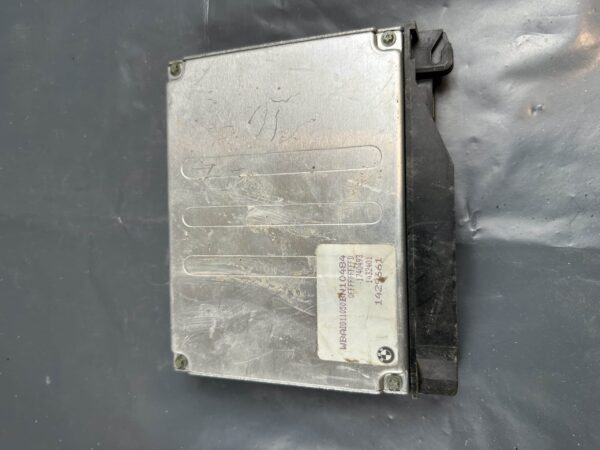


Mercedes W220 S-Class Airmatic Suspension Control Module Common Faults
The Airmatic suspension control module on the Mercedes W220 S-Class is the electronic brain behind the air suspension system, managing compressor operation, valve block control and ride height sensors simultaneously. When this module fails, the suspension loses the ability to self-level, the car drops to bump stops overnight, and warning lights appear across the dashboard. It is one of the most frustrating and misdiagnosed electrical faults on the W220 platform.
Quick Answer: What Happens When the W220 Airmatic Module Fails?
The Airmatic control module (also called the EAS control unit) is located in the right rear wheel arch area on most W220 builds. When it fails, the suspension can no longer communicate with the compressor or the individual corner valves, so the car sits unevenly or completely collapses to the lowest position. You will typically see a “STOP Vehicle Too Low” message and the Airmatic warning in the instrument cluster. The fault is almost always electronic — the compressor itself may still be perfectly functional.
Who Is Affected?
This fault affects all Mercedes W220 S-Class models built between 1998 and 2006 that were equipped with the Airmatic DC or Airmatic Plus suspension. Specifically:
- S320, S350, S430, S500, S600 (W220) — all years 1998–2006 with Airmatic option
- S55 AMG and S65 AMG variants also share the same module architecture
- Long-wheelbase (V220) models are equally affected
- Facelift models (2003–2006) use a slightly revised module but fail in identical ways
Cars that have been parked unused for extended periods are disproportionately represented in workshop cases. The module suffers moisture ingress through cracked connector seals, and the electronics corrode internally over time. For comparison, see Mercedes W220 S-Class ABC Suspension Control Module Faults Guide.
Symptoms You Will Notice First
Most owners describe a sequence that starts subtly and escalates quickly. The car might sit slightly lower on one corner after standing overnight. Then the compressor starts running noticeably longer than usual. Eventually the system gives up and the dashboard fills with warnings. Here is what the typical progression looks like:
- Uneven ride height — one corner visibly lower than others
- Car fully lowered to minimum height on startup
- Compressor running continuously without achieving target pressure
- “Airmatic Visit Workshop” message in the instrument cluster
- Harsh, jarring ride due to suspension locked in hard mode
- Intermittent self-levelling that works sometimes and not others
Occasionally the module will produce intermittent faults — the car sits fine for three days then drops overnight. This intermittency makes it genuinely difficult to pin down without proper diagnostic equipment.
Common Error Codes
| Fault Code | Description |
|---|---|
| B1005 | Airmatic control unit internal fault |
| B1010 | Compressor relay circuit open or shorted |
| B1015 | Front left height sensor signal implausible |
| B1016 | Front right height sensor signal implausible |
| B1020 | Rear left height sensor circuit fault |
| B1021 | Rear right height sensor circuit fault |
| B1030 | Valve block solenoid circuit fault — front axle |
| B1035 | Valve block solenoid circuit fault — rear axle |
| U1120 | CAN communication loss with Airmatic module |
It is worth noting that B1015 through B1021 sensor codes often appear because the module itself cannot communicate with the sensors — the sensors are frequently fine. Always confirm sensor wiring before condemning a height sensor based on a code alone.
What Causes the Module to Fail?
The W220 Airmatic module was not designed with the longevity expectations that modern electronics demand. The most consistent root cause is moisture. The module sits in an exposed location in the wheel arch area, and the connector seal degrades over time. Water tracks along wiring looms and into the connector pins, causing corrosion on the PCB inside the module. Cold climate vehicles and those that have seen car wash abuse are worst affected.
Secondary causes include voltage spikes from a failing battery or alternator damaging the module’s internal regulator, and heat cycling over 15–20 years that causes solder joint fatigue on the main processor board. A related diagnostic guide is Mercedes W220 S-Class Airmatic ECU Faults Diagnosis and Repair Guide.
Common OEM Part Numbers
The following OEM numbers are associated with the W220 Airmatic control module depending on build date and specification:
- A2203200197 — early W220 (1998–2002) Airmatic control module
- A2203200497 — revised module for 2002–2004 build dates
- A2203201197 — facelift W220 module 2003–2006
- A2203200997 — long-wheelbase V220 variant
- A2203202297 — S55 AMG and S600 specific module
Always cross-reference the chassis number and build date before ordering — the W220 used multiple hardware revisions across its production run. A module that looks externally identical may have different internal firmware and will cause coding issues if fitted to the wrong build year.
Repair or Replace? A Practical Workshop View
Repairing the module is possible if the fault is limited to connector corrosion or a single failed capacitor on the power supply rail. Specialist electronics repair shops can reflow solder joints and replace damaged capacitors for around 80–150 EUR. However, if the main processor or CAN transceiver chip is damaged, repair becomes unreliable and the cost approaches replacement anyway.
A tested used OEM module is the most cost-effective route for most owners. New genuine Mercedes modules for the W220 are still available but carry a price that rarely makes sense for a vehicle of this age. The key with a used module is ensuring it comes from a matching build year vehicle and that it has been bench-tested before shipping. Untested pulled modules from dismantlers carry a real risk of the same failure mode.
FAQ
Why does my Mercedes W220 sit low overnight but raises up after driving?
This is the classic symptom of a slow air leak — either from an air spring, a valve block solenoid or a leaking compressor outlet. The Airmatic module raises the car on startup because it detects the height drop through the sensors. If the module itself is faulty, it may not raise the car at all. Running a leak-down test with STAR Diagnosis or Autel equipment while the car sits overnight will confirm whether it is a leak or a module communication fault. For additional context, read Mercedes W220 S-Class ABC Hydraulic Control Unit Faults Guide.
Can I drive a W220 with a failed Airmatic module?
Technically you can drive it in an emergency, but it is not advisable. With the suspension locked at minimum height or in hard mode, the ride quality is severely compromised and the air springs can be damaged by running deflated over bumps. The steering geometry also changes at extreme ride heights, which affects handling. Get the fault diagnosed promptly rather than daily driving it in this condition.
How do I identify which module generation I need for my W220?
The build date plate inside the driver door jamb gives you the exact production date. Cross this with the original OEM part number sticker on the existing module — it is usually on the module housing itself. Alternatively, any competent Mercedes specialist can read the module’s part number via STAR Diagnosis when the car is connected, even if the module is partially functional.
Will a W220 Airmatic module work without coding after replacement?
Basic functionality may return without coding, but the module will typically require variant coding to match the car’s suspension configuration (standard or Airmatic Plus), axle load settings, and regional market specification. Without coding, height calibration values may be incorrect and additional fault codes can appear. Always perform a full coding and calibration procedure after fitting a replacement unit.
Are there any reliable alternatives to genuine OEM Airmatic modules for the W220?
Aftermarket alternatives exist but have a poor track record on the W220. The Airmatic system is sensitive to signal timing and voltage thresholds, and generic modules rarely match the OEM tolerances closely enough for stable long-term operation. Tested used OEM modules from matching-year donor vehicles consistently outperform aftermarket alternatives in workshop experience. European-sourced used OEM units with documented testing history are the standard recommendation among W220 specialists.
Find tested OEM electronic parts and modules at:
https://giantparts.eu/
Related diagnostic guides and OEM parts
- Mercedes W220 S-Class Instrument Cluster Faults Diagnosis and Repair
- Mercedes W220 S-Class EIS Ignition Switch Module Faults Guide
Related available product: 2205450732 Mercedes-Benz W220 Suspension Control Module – OEM Used & Tested
Browse the category: Модули за управление на окачването и ECU